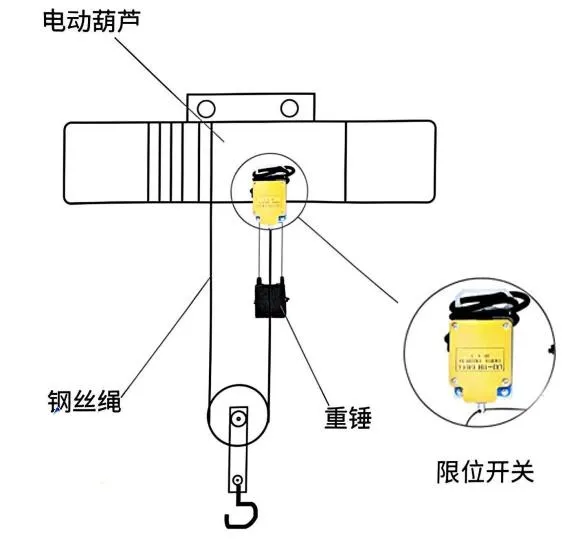
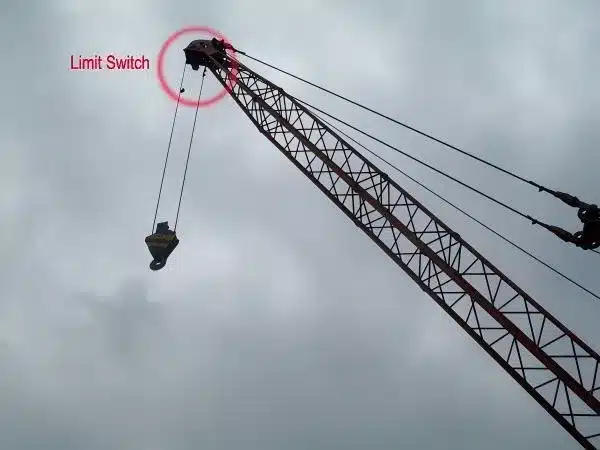
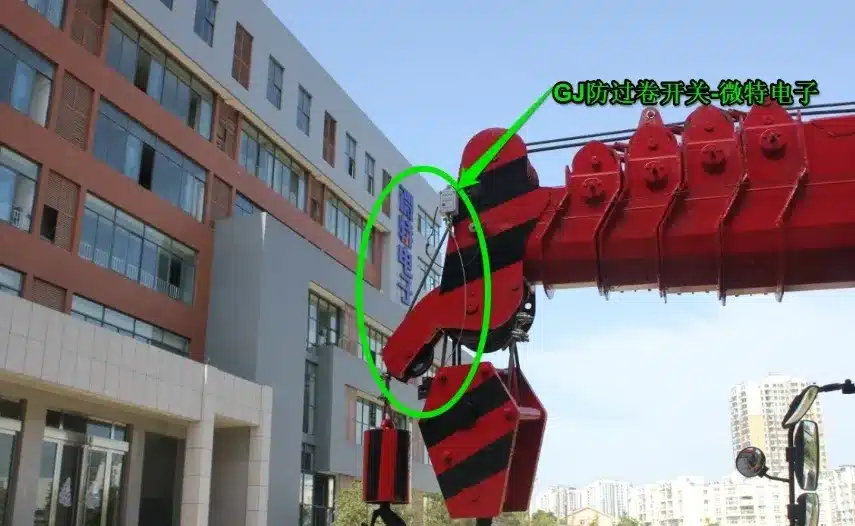
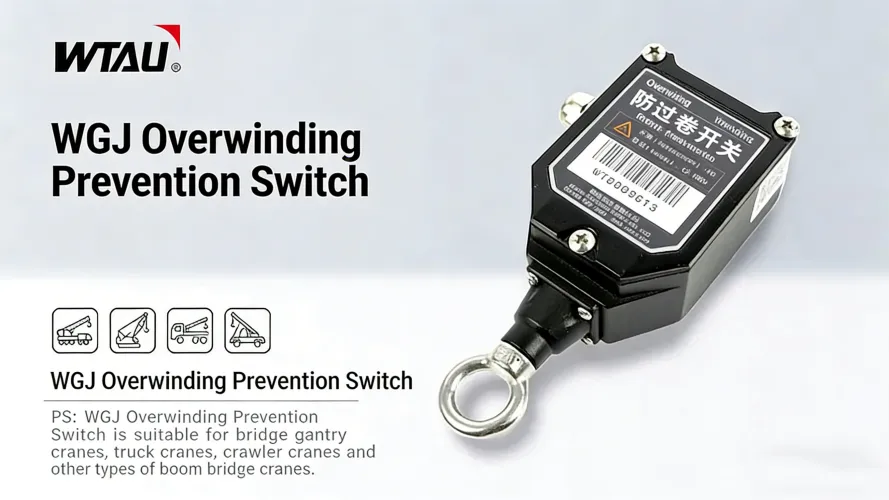
Hammer limit switch(Also known as anti-rollover switch, hammer-type height limiter) is a kind ofMechanically triggered safety protection switch, Widely used in cranes, electric hoists and other lifting equipment, the core role isPrevent the hook from rising too high (rushing to the top), To avoid breaking the wire rope, damaging equipment or causing safety accidents.
1. Structure composition
It is mainly composed of three parts:
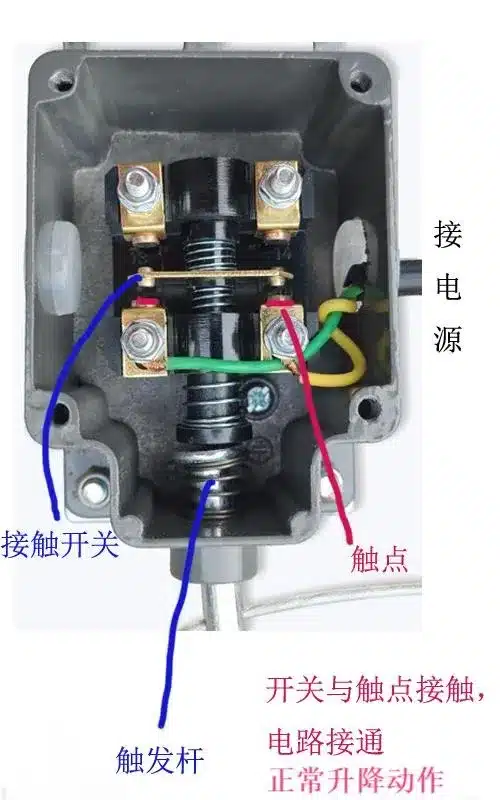
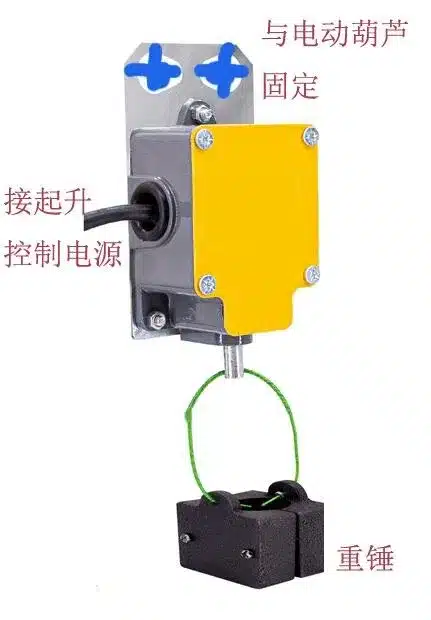
- Limit switch body: Contains micro-moving contacts, lever /swing arm mechanism.
- Heavy hammer: Heavy metal objects, providing gravity trigger force.
- Connecting wire rope / tie rod: Connect the hammer to the switch swing arm.
Second, the working principle
Core logic: the gravity of the hammer maintains the switch closed; the hook supports the hammer→ the switch is disconnected→ the rising circuit is cut off.
- Normal working condition
The hammer sagges freely due to its own weight, and the swing arm/lever of the switch is tightened downwards through the wire rope, so that the inside of the switchNormally closed (NC) contacts remain closed, The rising control loop is energized, and the hook can be raised and lowered normally.
- Trigger protection status
When the hook rises to the setLimit heightWhen the hook pulley block will be directlyLifting hammer, The connecting wire rope is relaxed, and the switch swing arm is reset under the action of an internal spring,Normally closed contact disconnected.
- Protection effect
Contact disconnected → Cut off the coil loop of the ascending contactor (KM) → Power off on the ascending main circuit → HookStop rising immediately;The descending loop is not affected, You can still operate downwards.
Key features:Only protect the rising limit, Unable to control the drop limit.
3. Wiring method (general standard)
Hammer limit switch usually has 3 terminal blocks:Common terminal (C), normally open (NO), normally closed (NC).
1. Standard safe connection method (normally closed series, most commonly used)
Lifting safety specification requirementsNormally closed contacts (NC) must be used, The highest reliability.
- Wiring steps:
- Cut off the total power supply of the equipment.
- Found the lifting mechanismRising contactor coil control loop(Usually connected between the rise button and the contactor coil).
- Disconnect any line of the original control loop.
- The two threads that will be disconnected,Connected to the “common terminal (C)” and “normally closed terminal (NC)” of the limit switch respectively.
- After the wiring is completed, the power-on test: manually lift the hammer and the rise should be stopped immediately; put down the hammer and the rise function resumes.
- 2-wire system (simplest): Direct series C and NC Access to the rising control loop.
- 3-wire system (with signal feedback):
- C (public): Connect to the control line of fire
- NC (normally closed): Connect to the rising contactor coil
- NO (normally open): Can be connected to PLC input or alarm light (optional)
Fourth, the main points of installation and commissioning
- Installation location: The switch body is fixed to the bracket above the hoist/hoist; the hammer is suspended verticallyDirectly above the hookOn the path.
- Height setting: Adjust the length of the wire rope to ensure that the hook is at the limit of the distanceAbout 0.5 metersIt can reliably hold the hammer at the same time.
- Anti-interference: Avoid heavy hammer shaking and wire rope winding, and install a guide pipe if necessary.
- Dual limit configuration: The new regulations require lifting equipment to be equipped withDouble limit(Heavy hammer type + transmission type), heavy hammer asThe last line of security.
V. Summary of advantages and disadvantages
- advantages: The structure is simple, the cost is extremely low, the installation and maintenance are convenient, the operation is reliable, and it is not affected by the length of the wire rope.
- disadvantages: It can only prevent the top from rushing (no upper/lower limit), the action accuracy is general, and it is susceptible to shaking interference.