

Product introduction: content hide Solution 1: Flat-arm tower crane anti-collision system-radar full-dimensional monitoring Plan two: Boom tower crane defense……
In the construction process of modern smart construction sites, cross-operation of multiple tower cranes has become the norm. How to effectively avoid collision accidents between tower cranes and between tower cranes and obstacles? As a core safety monitoring device, theTower Crane Anti-Collision:builds a "firewall" for construction safety by real-time monitoring all operational data of tower cranes and calculating 3D spatial parameters.
Weite (WTAU) has launched three highly representativeTower Crane Anti-Collision:solutions for different machine types and construction scenarios.
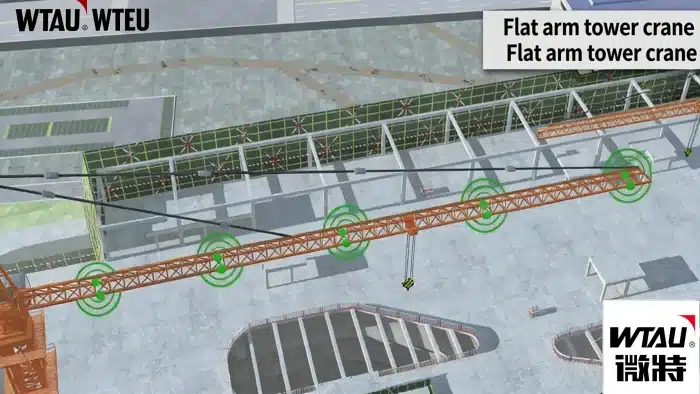
Hammerhead cranes are the most common type of crane on construction sites. Tailored to their operational characteristics,Tower Crane Anti-Collision:developed by WTAU focuses on dynamic horizontal protection.
Technical Implementation: High-precisionradar sensorsare installed on both sides of the crane jib to achieve full scanning of the surrounding environment.
Early warning logic: When the sensors detect that the distance between the crane jib and surrounding objects (such as adjacent tower cranes, building edges) reaches the set safety boundary, the system will automatically issue an audible and visual alarm to remind the operator.
Data interconnection: Monitored data can be transmitted in real time to the large screen in the central control room via wireless networks (4G/5G) to realize remote supervision.
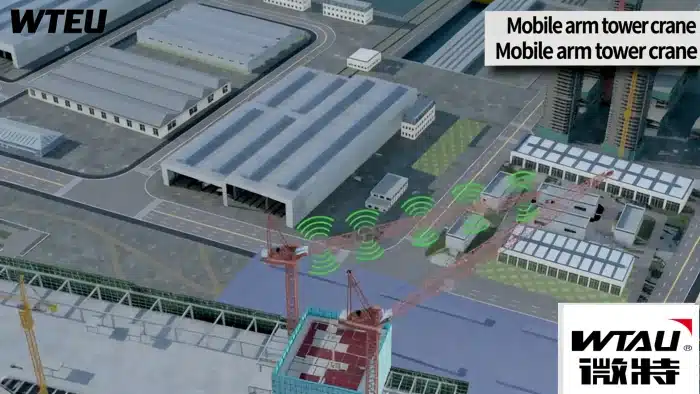
The jib of a luffing jib crane can luff up and down, with a spherical operational space and a more complex trajectory.Tower Crane Anti-Collision:adds vertical spatial calculation.
Technical Implementation: In addition to the same radar sensors as those used for hammerhead cranes, an angle sensor (luffing sensor) is additionally installed at the root of the crane jib.Angle sensor (amplitude sensor).
Core advantages: By real-time monitoring the pitching angle and horizontal position of the crane jib, the system dynamically restores the actual trajectory of the crane in 3D space, providing all-round protection for the operational safety of luffing jib cranes during complex lifting and lowering processes.
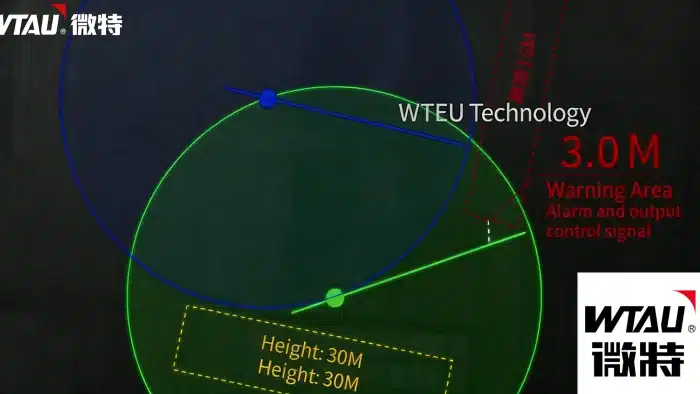
In the complex environment of "group crane" operation, single-machine anti-collision can no longer meet safety requirements, and anactive anti-collision systemmust be introduced. This system is not only applicable to tower cranes but also extendable to various hoisting equipment such as gantry cranes and bridge cranes.
Full-Parameter Sensing
Azimuth meter: Monitors the precise orientation of the tower crane.
High-precision encoder: Captures the rotation speed and hook height position in real time.
QXZ sensor: Detects the jib pitching angle.
Active Intervention Function: The system pre-defines the coordinates of construction site obstacles (electronic fence). When the tower crane jib or hoisted load approaches a restricted area or other tower cranes,Tower Crane Anti-Collision:Will triggeractive controland forcibly stop the operation in the dangerous direction to ensure absolute hoisting safety.
Versatility for Dock/Group Operation: This principle is similar tothe anti-collision system for dock crane groups,serving as the ultimate solution to safety problems in large and complex construction sites.
ModernTower Crane Anti-Collision:no longer operate in isolation, but integrate powerful digital capabilities:
Remote access and storage: All historical operation trajectories and alarm records support cloud storage, facilitating accident traceability and safety audits.
Wireless Large Screen Linkage: On-site data is synchronized to the construction site smart center in real time, allowing managers to monitor the hoisting progress of multiple tower cranes globally in the central control room.
Efficient Collaborative Operation: The remote scheduling function reduces on-site communication interference and significantly improves the overall coordination efficiency of group crane operation.
When selecting aTower Crane Anti-Collision:it is necessary to comprehensively consider the number of on-site tower cranes, the distance between crane bodies and the complexity of surrounding obstacles.
Single Crane Operation: It is recommended to select the radar sensor sensing solution.
Complex Group Crane Operation: A multi-tower collaborative anti-collision system with "active braking" function must be equipped.
Recommended Reading: How to Choose Wtau Anti-Collision System? A Complete Guide
(Overseas) Tower Crane Anti-Collision System for Bogotá Metro Construction.
Next Article:Fruitful 2025 & New Journey in 2026 for Wtau »
24-Hour Service Hotline: 0717-6922999 WeChat: 13972023522 Email: technical@wtauserver.com Address: No.6 Gangcheng Road, Yichang Area, China (Hubei) Pilot Free Trade Zone
Copyright © 2026 Wtau Technology Co., Ltd. All Rights Reserved. ICP License No.: E ICP 12004023-1