In modern industrial manufacturing, port logistics and construction, lifting machinery, as high-risk special equipment, its operation safety is directly related to the life and property of the enterprise. With the continuous increase of national supervision of special equipment, a set of fully compatibleTower crane, bridge crane, gantry craneAnd many other models, and fully comply with national standardsCrane safety monitoring and management system, Has become the core standard for enterprises to achieve safe production compliance and move towards digital transformation.
1. What is a crane safety monitoring and management system that meets the national standard?
Crane safety monitoring and management system(Commonly known as the "crane black box”) is a digital security protection system that integrates Internet of Things sensors, intelligent control terminals, wireless communications and big data analysis.
The system collects operating data in real time by installing sensors in key parts of the crane, and automatically triggers sound and light alarms and even forcibly cuts off the power supply in dangerous directions in the event of dangerous signs such as overload, overspeed, overturning, collision, etc. At the same time, the system has an immutable data storage function, which provides accurate data support for accident traceability and daily maintenance.
According to the requirements of the State Administration of Market Supervision and Administration and the safety technical specifications for special equipment, large-tonnage and high-risk lifting machinery must be equipped with equipment that meets the requirements of regular inspections (special inspections). GB/T 28264-2017 "Safety Monitoring and Management System for Lifting Machinery" Standard system.
2. Core national standard matrix: unified monitoring of multiple models of tower crane, bridge, and gantry crane
Different types of cranes have very different operating environments and hazard sources. Enterprise levelCrane safety monitoring and management systemIt must have strong compatibility and deploy differentiated monitoring matrices for different models to ensure that all indicators meet the mandatory requirements of the national standard.:
1. ️Tower crane (tower crane) safety monitoring
- Monitoring focus: Torque, inclination angle and multi-machine anti-collision.
- National standard core parameters: Lifting moment, lifting weight, lifting height, rotation angle, amplitude, tower inclination angle.
- Featured protection: High-altitude environmental wind speed monitoring, multi-machine anti-collision algorithm for group tower operations, regional no-entry protection, and hook visualization video system.
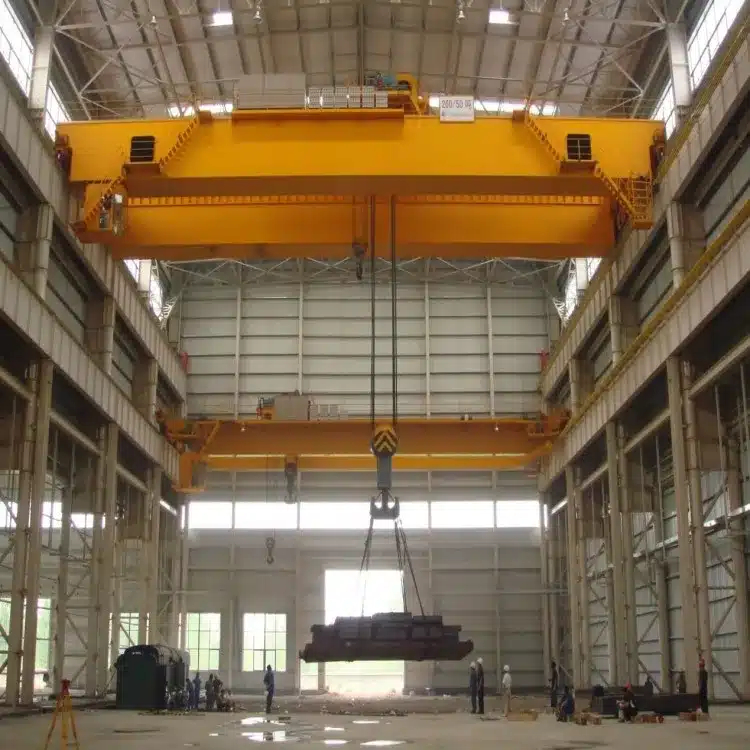
2. High-speed bridge/gantry crane safety monitoring
- Monitoring focus: Overload protection, operating stroke and track limit.
- National standard core parameters: Lifting weight, lifting height, trolley operating stroke, trolley operating stroke, operating speed.
- Special scene: For high-risk bridge cranes such as metallurgy, explosion-proof, and insulation, the system needs to have reel winding, blind spot monitoring of cart tracks, and a higher dust-proof and explosion-proof level.
3. Elevator gantry crane safety monitoring
- Monitoring focus: Video of amplitude change, door seat level and multiple blind spots in the port.
- National standard core parameters: Lifting weight, lifting height, luffing amplitude, rotation angle, cart walking stroke, door seat inclination, real-time wind speed.
- Featured protection: Video of blind spots in the grab/hook work area, anti-collision of adjacent aircraft, and monitoring of track anchoring status.
3. "Distributed acquisition + centralized cloud platform": multi-model integrated system architecture
In order to make the tower crane, bridge crane, and gate crane in the factory or construction site no longer form an "information island", advancedCrane safety monitoring and management systemAdopt a three-layer technical architecture to realize centralized data control:
- Hardware layer (on-site data acquisition): Install an intelligent monitoring terminal compatible with GB/T 28264 standard on each crane. The system has a built-in self-diagnosis function, and once the sensor fails, it will actively report an error. The data is stored locally with non-tampering encryption, and the regular records are kept for not less than 30 days, and the alarm records are permanently retained.
- Network layer (hybrid networking transmission): For fixed bridge machines in factories, optical fiber or industrial-grade Wi-Fi/5G private network transmission is used; for building tower machines or port-dispersed landline machines, 4G/5G wireless cellular networks are used directly to the cloud.
- Application layer (smart security large screen): The management software aggregates the data of all models on one kanban board. The status of the equipment is reproduced in real time through digital twin technology (three-dimensional model), and hierarchical early warning (90% early warning, 105% control of power failure) and mobile APP remote supervision functions are provided.
4. Selection and inspection: How can an enterprise ensure that 100% of the system passes the special inspection?
Purchasing or retrofittingCrane safety monitoring and management systemAt this time, enterprises should focus on reviewing the following compliance indicators to avoid special equipment failing the annual inspection due to hardware non-compliance:
- Review of type test report: The system supplier must provide the "Type Test Certificate" or "Type Test Report" issued by the national special equipment inspection agency, and the report must clearly indicate that the product meets the requirements. GB/T 28264 standard.
- Confirm data interface and openness: The system should support standard Modbus, MQTT or construction industry-specific data protocols in order to seamlessly connect with the Local Housing and Construction Bureau (tower crane real-name system platform) or the Quality Supervision Bureau's special equipment intelligent supervision platform in the future.
- Consider the whole life cycle maintenance: Choose a manufacturer with independent research and development capabilities. The system must not only be able to ”see“, but also provide the crane's ”remaining life prediction (structural fatigue analysis)" and intelligent maintenance tips based on historical operation data.
Conclusion
An excellent set ofCrane safety monitoring and management system, is not only a “compliance tool” to deal with national security inspections, but also a “safety guard” for enterprises to improve production efficiency, reduce accident rates, and realize digital asset management. By opening up the underlying data of tower cranes, bridge cranes, and gate landline aircraft, enterprises can truly build a comprehensive and non-dead-end digital security line of defense for special equipment.