

Gate load gaugeAlso known as gate load measuring and controlling instrument and gate load monitor, it is a special safety monitoring instrument used in conjunction with the hoist in water conservancy and hydropower projects. It is mainly used to measure the tension of the wire rope and the actual load value of the gate during the lifting of the gate in real time, and display the current load of the gate in real time. When the opening and closing load is overloaded, it is mainly used to measure the tension of the wire rope and the actual load value of the gate during the lifting of the gate., Partial load, stuck resistance and other abnormal working conditions, timely alarm signals are issued, which is an essential safety protection device for the opening and closing equipment of reservoirs, pumping stations, and irrigation areas.
When the gate is lifting and running, it is easy to encounter hidden dangers such as silt adsorption at the bottom, debris stagnation, uneven force on both sides, and overload of opening and closing. If there is no load monitoring equipment, the opening and closing motor, wire rope, and reel are prone to overload and fracture, causing the gate to fall, equipment damage and other major safety accidents. The gate load gauge can monitor changes in the opening and closing load online around the clock, so as to avoid the operating risks caused by gate blocking and overloading from the source. Many models can be used with gate opening sensors to formDual monitoring system of opening and load, At the same time collect the height and load data of the gate position.
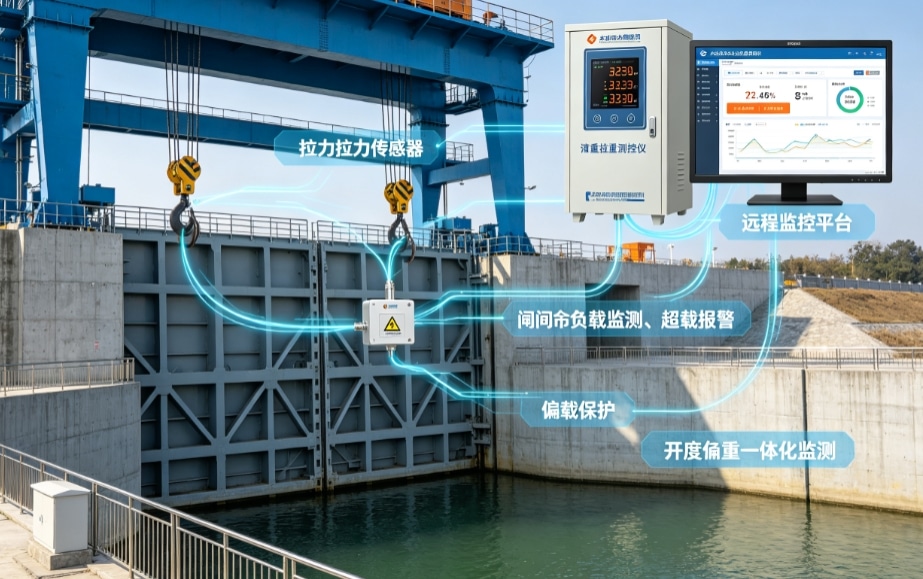
The gate load gauge consists of three parts: a load sensor (tension sensor), a signal transmission cable, and an intelligent measurement and control host. When the hoist lifts the gate, the tension of the wire rope is transmitted to the tension sensor, and the sensor converts the physical tension signal into an electrical signal and transmits it to the host of the gate load gauge; after the host calculates and filters the signal, the current actual load value of the gate is converted, and the screen displays the load in real time. Can be pre-set inside the deviceRated load, overload alarm threshold, partial load difference threshold。 Once the monitoring load exceeds the set upper limit, or the difference between the load of the hanging points on the left and right sides is too large, the instrument will immediately sound and light an alarm, and the switch signal can also be output to linkage the opening and closing control system to achieve shutdown protection and prevent the lifting gate from continuing with a fault.
Real-time display of the actual load value of the gate lifting and the percentage of the load in the rated lifting weight. The operator can visually view the current force of the gate on the spot to determine whether the gate lifting is smooth or stagnant.
You can customize the overload warning value and overload shutdown value. The lifting load of the gate exceeds the early warning value, the first sound and light reminder; the overload limit value is reached, the protection signal is output, and the linkage opening and closing control cabinet is cut off the rising circuit, and the forced lifting of the gate is prohibited to protect the wire rope, reducer, and motor of the opener.
For the dual hanging point gate, the instrument compares the load of the hanging point on the left and right sides in real time. When the tension difference between the two sides exceeds the allowable range, it is determined that the gate is tilted and stuck, and the alarm is quickly raised to avoid distortion and stuck due to uneven force on the gate.
The host comes with its own operation log storage to record the maximum load and alarm event time of each gate opening and closing, and the historical records can be queried and exported at any time to facilitate the traceability of faults afterwards and keep the gate operation files.
A measuring and controlling instrument is connected to the load signal + gate opening signal at the same time, and the screen simultaneously displays the current opening position and load value of the gate, so as to achieve dual position‑load control.
It supports RS485, Modbus, and 4‑20mA standard industrial signal output, and the data can be uploaded to the remote information monitoring platform of the gate and the central control room of the water conservancy pumping station to realize the remote supervision of the gate unattended.
1.Tension sensor: Generally installed in the lug of the hoist, under the wire rope reel, and in the position of the moving pulley block; 1 set of tension sensors is installed at the left and right hanging points of the double hanging gate.;
Note: When the sensor is installed, it should avoid hard friction with the steel structure of the gate, do a good job of waterproof, moisture-proof and anticorrosive protection, and adapt to the outdoor humid and foggy water conservancy site environment. 2、Load measurement and control instrument host: Installed inside the control cabinet of the hoist or on the operation console of the hoist machine room to facilitate operators to view data on site.
Suitable for hoist type hoist, screw hoist, hydraulic hoist; widely used in reservoirs, dam, river locks, pumping stations, irrigation areas, hydropower stations, flood control gates, drainage gates and other water conservancy projects.
1. Regularly check the wiring and waterproof joints of the tension sensor for loosening by moisture; 2. Calibrate and verify the load accuracy of the gate load gauge every year to ensure the accuracy of the measurement data; 3. Clean up the surface of the sensor for sediment and rust, and do a good job of anti-corrosion maintenance; 4. Check the alarm threshold parameters to avoid false alarms or alarm failures..
Next Article:Gate remote control system: intelligent linkage scheme of reservoirs, channels and drainage pumping stations »
24-Hour Service Hotline: 0717-6922999 WeChat: 13972023522 Email: technical@wtauserver.com Address: No.6 Gangcheng Road, Yichang Area, China (Hubei) Pilot Free Trade Zone
Copyright © 2026 Wtau Technology Co., Ltd. All Rights Reserved. ICP License No.: E ICP 12004023-1