

For factory equipment managers, the increase in the number of cranes means that production scheduling is more flexible, but it also brings a problem.:How to ensure that each crane can operate safely in its own operating area?
Traditional anti-collision devices usually detect the distance between the devices through limit switches, ranging sensors, etc. However, in some complex industrial sites, the danger does not necessarily come from another crane, but may also come from steel pipes, steel, protruding parts of equipment, or even other temporary obstacles that suddenly enter the operating area.
If the system can only detect pre-set fixed positions, it will be difficult to meet the needs of active anti-collision under complex operating conditions.
This is also why more and more companies are beginning to pay attentionCrane lidar anti-collision systemThe reason. Through laser scanning technology, the system can sense the objects around the crane, obtain the distance and location information of obstacles, and then realize active early warning and anti-collision control according to the pre-set safety area and control logic.
When I came into contact with the application scenarios of industrial lifting equipment, I found that many companies did not install anti-collision devices, but that the original protection methods were difficult to cover all operating scenarios.
Especially in large-scale factories, with large crane operating space, a large number of equipment, and a complex operating environment, the risk of collision may occur in multiple locations.

This is a more common situation in factories.
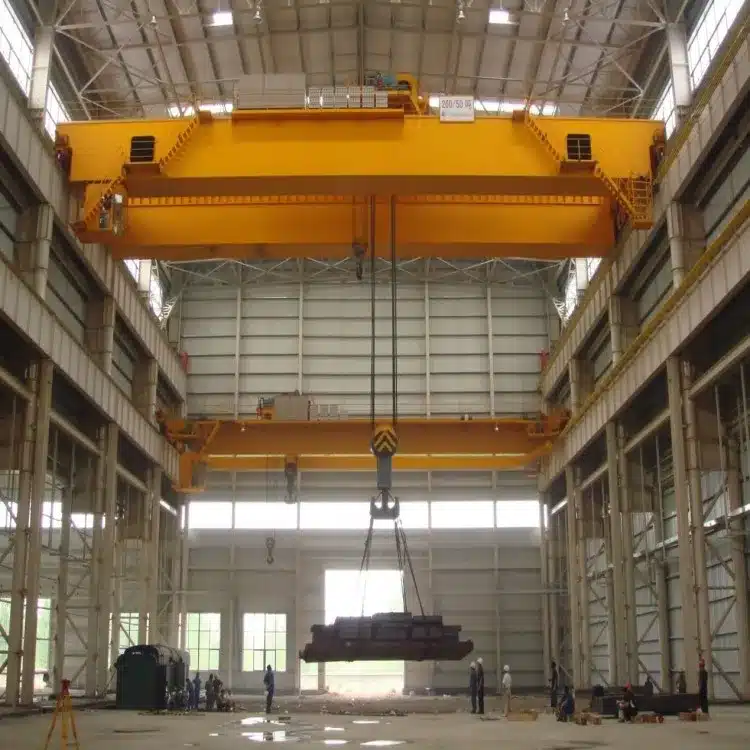
Two or even more bridge cranes are installed on the same track, and they may be responsible for material handling tasks in different production areas.
When two cranes are running in the same direction at the same time, or approaching each other from opposite directions, if the operator does not notice the location of the other equipment in time, a collision may occur.
In this case, enterprises usually need to install anti-collision devices between cranes to detect the relative distance between the two equipment in real time.
When the distance enters the early warning range, the system issues an alarm; when the set dangerous distance is reached, the system outputs a deceleration or stop signal to the control system.
Some large-scale industrial plants adopt the design of upper and lower double-decker cranes.
For example, the upper crane is responsible for the lifting of large-scale raw materials, and the lower crane is responsible for the transfer of materials near the production line.
This layout can improve the space utilization rate of the plant, but it also increases the risk of space interference between equipment.
When the upper and lower cranes are running, not only the distance between the two carts needs to be considered, but also whether the hooks, wire ropes, spreaders, and hoisting loads of the upper cranes will enter the operating space of the lower equipment.
If only the horizontal distance between the carts is detected, it may not be possible to fully determine whether there is a risk of collision between the hook and the load.
Therefore, the anti-collision of the upper and lower cranes needs to be designed in combination with the height of the equipment, the operating position and the actual interference area.
Such problems are also more common in the production workshop.
For example:
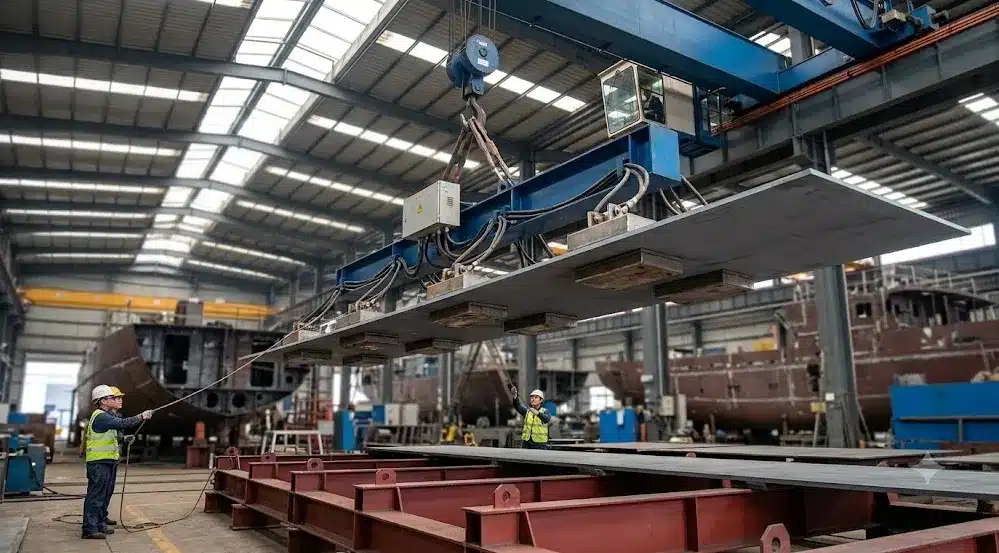
Steel pipes and steels temporarily placed during production;
Tools or materials left in the operating area after equipment maintenance;
Mechanical parts that protrude beyond the contour of normal equipment;
Other equipment that temporarily enters the operating area of the crane.
These obstacles may not be fixed, and their location and shape may not be the same.
If the anti-collision system can only identify targets in fixed positions, it will be difficult to cope with this dynamically changing on-site environment.
This is also an application direction of lidar anti-collision system that deserves attention: in addition to detecting the distance between cranes, it can also detect obstacles in the set scanning area.
At present, there is not only one technical route for crane collision prevention. Different equipment and different operating environments can use limit switches, laser ranging, infrared, ultrasonic, radar and other methods.
The problem is that the application scenarios suitable for different detection methods are not the same.
Mechanical limit switch is a more traditional protection method.
Usually, a limit device is installed at a specific location on the crane's operating track. When the equipment is running to the corresponding location, a switch signal is triggered to slow down or stop.
Its advantages are simple structure, relatively low cost, and suitable for clear fixed position protection such as end limit.
But it also has obvious limitations: it is usually necessary to determine the trigger location in advance, and it cannot actively perceive obstacles in different locations within the scanning range like an area scanning device.
Ordinary laser ranging sensors usually emit lasers in a specific direction to measure the distance between the target object and the sensor.
For example, by installing a laser ranging device between two cranes on the same track, the distance between the two equipment can be obtained.
This method is suitable for targets with a clear detection position and a fixed measurement direction.
However, if you want to detect obstacles in multiple directions and different locations at the same time, the single-point ranging method may require an increase in the number of sensors and installation location.
Unlike single-point laser ranging, lidar can continuously obtain distance information in multiple directions within a certain scanning angle.
Under the appropriate installation location and scanning configuration, the system can obtain the spatial information of surrounding objects and identify obstacles entering the preset area.
For example, there is a steel pipe in front of the crane. After the lidar scans the steel pipe, the corresponding distance information can be obtained. The control system determines whether early warning or protective action is required based on the relationship between the target location and the safe area.
It needs to be explained here: the scanning range, resolution and recognition ability of lidar depend on the specific model and installation configuration. Not all lidars can automatically recognize objects of any size.
Many equipment managers may have a question: after the lidar is installed on the crane, how can they tell if there are obstacles ahead?
In fact, the whole process can be understood as four steps: scanning, ranging, judgment, and control.
LIDAR is installed in the crane's cart, trolley or other location that needs protection.
During the operation of the equipment, the lidar obtains information about the surrounding environment according to the set scanning range.
When there is an object in the scanned area, the laser will generate corresponding measurement data.
Depending on the type of radar, the system can obtain two-dimensional scanning data or three-dimensional point cloud data.
Lidar transmits the collected data to the control system.
The system calculates the distance between the obstacle and the crane based on the scanned data, and determines whether the obstacle has entered a preset detection area.
For example, an obstacle appears in front of the crane, and the system can determine how far it is from the equipment based on radar data.
If the device supports more complex area perception, it can also analyze the location and spatial contours of obstacles based on the scanned data.
It is not necessarily necessary to stop if the object is scanned.
There are a large number of normal production equipment in the factory. If all objects trigger an alarm, it will affect the normal operation of the crane.
Therefore, the system needs to set the detection area and safe distance according to the site layout.
For example:
Normal operation area: The equipment can operate normally;
First-level early warning area: after the target is detected entering, sound and light alarms or deceleration prompts are triggered;
Secondary hazardous area: When the target distance is further shortened, a protection signal is output to the control system.
The specific area size and trigger conditions need to be determined in combination with the crane's operating speed, braking distance, control response time, and on-site safety requirements.
When the system determines that there is a risk of collision, it will transmit the corresponding early warning or control signal to the crane control system.
The control system performs deceleration, stop, or other protective actions based on pre-designed logic.
Here is an important detail:Lidar is responsible for environmental perception, and it is the supporting control system that truly performs the deceleration and parking of the crane.
Therefore, a complete crane lidar anti-collision system not only needs to choose a suitable radar, but also needs to consider the cooperation between signal processing, control logic and braking actuator.
For factory managers, the technical principle is not the most important, the key is whether it can solve the actual collision risk on the site.
Combined with the operating characteristics of bridge cranes, I think there are mainly the following types of applications.

Two cranes running on the same track can install lidar or corresponding ranging devices in directions close to each other according to the equipment arrangement.
The system obtains the distance between the two devices in real time, and reminds the driver to pay attention when entering the early warning area; when the dangerous distance is reached, it outputs a corresponding deceleration or stop signal.
This approach can reduce the risk of collision caused by the operator's restricted line of sight, distracted attention or untimely judgment.

The anti-collision of the upper and lower cranes is more complicated than the anti-collision of the same track.
Because although the two cranes are not operating at the same height, the hooks, wire ropes and hoisting loads of the upper equipment may enter the operating space of the lower crane.
Therefore, the system cannot simply compare the horizontal distance between the two carts.
It is necessary to combine the height of the upper and lower equipment, the operating position, the position of the hook, and the area where interference may occur to make a judgment.
Through the reasonable arrangement of lidar and supporting detection devices, the relevant areas can be monitored to reduce the risk of spatial interference between the upper and lower equipment.

This is an application that I think lidar is worth focusing on.
The traditional fixed position limiting device mainly protects the pre-determined target position.
Lidar can obtain the distance information of objects based on the scanned area.
For example, a steel pipe suddenly appears near the crane's operating track, or other materials protrude into the crane's operating space.
When these objects enter the effective scanning area of the radar and meet the detection conditions set by the system, the control system can determine whether to trigger an early warning or protection action based on the distance.
For factories that often adjust production layout and material placement changes greatly, this regional inspection method has practical application value.
This issue is worth discussing separately.
In the actual operation of the crane, the obstacles are not necessarily all large-scale equipment.
Sometimes it may be just a steel pipe, a section of profile, or a small part protruding from the outside of the equipment.
If the anti-collision system can only detect large objects, then for some smaller obstacles, the protection ability may be limited.
So, can lidar detect steel pipes with a diameter of 5 cm?
从技术原理上说,在合适的设备选型和安装条件下,激光雷达可以检测到这样的目标,但不能仅凭直径判断所有型号都能稳定识别。
The following factors mainly need to be considered.
During the scanning process, lidar will transmit or receive measurement signals at certain angular intervals.
The higher the angular resolution, the smaller the spatial interval between adjacent scanning points at the same distance.
Assuming that a steel pipe with a diameter of 5 cm is far away from the radar, if the radar angle resolution is insufficient, only a few scanning points may fall on the surface of the steel pipe, resulting in a decrease in detection stability.
Therefore, when choosing a device, you must not only pay attention to the maximum detection distance, but also pay attention to the relationship between the angular resolution and the actual detection distance.
Different materials and surface states will affect the measurement effect of lidar.
For example, the surface color, gloss, reflectance, and the placement angle of the steel pipe may all affect the return of the laser signal.
For targets with special surface reflection characteristics, the detection effect needs to be verified through on-site testing.
Even if the performance of the radar itself is sufficient, if the installation location is unreasonable, there may be blind spots for detection.
For example, if the steel pipe is located above or below the scanning plane, and the radar scanning beam does not cover the location of the steel pipe, the target may not be detected.
Therefore, the installation needs to be designed in combination with the operating space of the crane, the possible location of obstacles, and the radar scanning plane.
If the steel pipe is obscured by other materials, or there is an equipment structure blocking between the radar and the steel pipe, it may affect the detection.
This is why lidar anti-collision systems cannot only look at product parameters, but must also be installed and debugged in combination with the actual plant environment.
For projects with clear requirements for the detection of small-size obstacles, I suggest that the target size, detection distance and installation location requirements be put forward at the equipment selection stage, and the on-site testing can confirm whether the detection can be stable, rather than waiting until the installation is completed before verification.
From a management point of view, I believe that the value of the lidar anti-collision system is not just to add a detection equipment, but to gradually shift the safety management of the crane from relying solely on the observation of the operator to the active perception of the equipment.
It is mainly reflected in the following aspects.
Crane drivers need to pay attention to the lifting cargo, operating direction, surrounding equipment and production personnel during operation.
If there are multiple equipment cross-operating at the same time, relying only on manual observation, it is difficult to continuously pay attention to the risk of collision in all directions.
Lidar can continuously scan the set area, providing additional safety protection for drivers.
The production layout of the factory may change frequently.
Steel is placed in a certain location today, and it may be replaced with other equipment or materials tomorrow.
By adjusting the scanning area and detection logic, part of the protection range can be changed according to the actual situation on the site, reducing the dependence on fixed detection locations.
With the development of intelligent manufacturing and automated logistics, more and more factories are beginning to pay attention to the automatic operation of cranes.
Automation equipment not only needs to know where it is, but also whether there are other equipment and obstacles around it.
Lidar can provide environmental perception data, which provides the basis for the area protection, automatic operation and intelligent control of the crane.
It should be noted that LIDAR itself is not equivalent to an autonomous driving system. To achieve automatic operation, it is also necessary to combine systems such as position detection, motion control, task scheduling, and safety control.
The layout and operating environment of cranes in different factories vary greatly, so all anti-collision problems cannot be solved directly with the same configuration.
In the actual project, I suggest focusing on the following aspects.
First, clarify the objects that need to be protected.
Is it the anti-collision between two cranes of the same track, or the detection of spatial interference between the upper and lower cranes? Or is it to detect ordinary obstacles in the operating area of the crane?
Different targets have different requirements for radar installation location and scanning method.
Second, confirm the detection distance and target size.
If you only need to detect adjacent cranes, the focus is on the effective ranging range between the equipment.
If it is also necessary to detect small-size obstacles such as steel pipes with a diameter of 5 cm, further attention must be paid to the radar angle resolution, scanning frequency and actual detection effect.
Third, consider the operating speed and braking distance of the crane.
The anti-collision system is not that the closer the distance, the better the alarm.
If the crane is running at a fast speed, it takes time for the control system to respond and the mechanical braking, and sufficient safety margin must be left for the early warning distance.
Fourth, confirm the interface and protection logic of the control system.
It is necessary to clarify how the lidar is connected to the crane PLC, frequency converter or other control equipment, and what actions correspond to the different early warning levels.
Fifth, consider the on-site environment and maintenance conditions.
Dust, vibration, high temperature and oil pollution may exist in steel plants, metallurgical plants and other places, and issues such as radar protection level, installation protection, and mirror cleaning and maintenance need to be considered.
In addition, for key protection functions involving personnel safety, it is also necessary to design corresponding safety loops based on equipment risk assessment and applicable safety standards. Ordinary radar output signals cannot be simply equated with safety certification protection functions.
In the past, the factory installed crane anti-collision devices, more to avoid direct collision between the two equipment on the track.
However, with the increase in the number of cranes in the plant and the increasing complexity of production equipment, the scope of anti-collision management is also expanding.
Now, enterprises not only need to pay attention to the distance between the crane and the crane, but also need to consider the spatial interference of the upper and lower equipment, the operating range of hooks and hoisting objects, and temporary obstacles entering the work area and other issues.
This means that the crane anti-collision system needs to gradually develop from a single distance detection to area perception and active protection.
Micro-special crane lidar anti-collision systemIt can design corresponding radar installation plans and detection areas around the equipment layout and operating conditions of different factories, so as to realize applications such as anti-collision of multiple cranes on the same track, anti-collision of upper and lower cranes, and obstacle detection in the operating area.
For enterprises where multiple cranes cross-operate and traditional anti-collision devices are difficult to cover all risks, targeted anti-collision plans can be formulated based on the number of on-site equipment, track layout, operating speed and obstacle types.
In the actual project, I would suggest to clarify the objects and hazardous areas that need to be detected first, and then determine the radar model, installation location and control logic. In this way, lidar can truly solve on-site problems, rather than just adding a sensor to the crane.
Next Article:How to choose the instrument of lifting equipment? One table + five-step method, you will see it after reading it »
24-Hour Service Hotline: 0717-6922999 WeChat: 13972023522 Email: technical@wtauserver.com Address: No.6 Gangcheng Road, Yichang Area, China (Hubei) Pilot Free Trade Zone
Copyright © 2026 Wtau Technology Co., Ltd. All Rights Reserved. ICP License No.: E ICP 12004023-1