

Crawler cranes are common lifting equipment in the construction of large-scale projects and are widely used in bridge construction, wind power installation, petrochemical industry, large-scale steel structure hoisting and other fields. Compared with ordinary lifting equipment, crawler cranes have the characteristics of large lifting weight, wide range of operating radius changes, and complex hoisting conditions. In the actual construction process, factors such as equipment load, lifting moment, boom angle, lifting height, and on-site wind speed will affect the safety of hoisting operations.
In order to grasp the operating status of crawler cranes in real time and reduce the safety risks caused by overload, over-torque and abnormal working conditions, the installation of crawler crane monitoring system is an important technical means.
Crawler crane monitoring systemThe operating parameters of the equipment are collected through sensors, and the on-site data is transmitted to the monitoring terminal. After system analysis and judgment, the operating status display, overrun warning, data recording and other functions are realized. The system not only needs to have reliable data acquisition capabilities, but also needs to pay attention to the installation quality of the sensors. Incorrect force direction of the sensor, uneven installation structure, or lax sealing of the junction box may affect the accuracy of the monitoring data.
This article will introduce the working principle and application points of the crawler crane monitoring system from the aspects of system composition, main monitoring functions, sensor installation requirements, and safety early warning.

The crawler crane monitoring system is a set of safety monitoring equipment used to monitor the operating status and hoisting operation parameters of crawler cranes. Through various sensors installed on the crane, the system collects parameters such as lifting weight, lifting moment, boom angle, lifting height, and working range in real time, and transmits data to the cab display terminal.
When the operating parameters of the equipment are close to or exceed the preset safety range, the system can remind the operators through sound and light alarms to help them keep abreast of the operating status of the equipment and avoid unreasonable hoisting operations.
A complete crawler crane monitoring system usually consists of the following parts:

Data acquisition sensor: According to the equipment structure and monitoring requirements, sensors such as weight, pressure, angle, length, and wind speed are configured to collect various parameters during the operation of the crawler crane.
Data processing unit: It receives various sensor signals, processes, calculates and analyzes the collected data, and provides a data basis for equipment status judgment.
Cab display terminal: Installed in the cab of the crawler crane, the operating parameters, working status and alarm information of the equipment are displayed in real time to facilitate the driver to grasp the current hoisting conditions.
Alarm device: When the monitoring parameters reach the early warning or alarm conditions, a prompt is issued through sound, light, etc. to remind the operator to pay attention to the operating status of the equipment.
Data recording and management module: According to the system configuration, equipment operation data, alarm information and related operation records are stored to provide a basis for subsequent equipment management, fault analysis and safety traceability.
There are differences in the structure, control methods and monitoring requirements of different types of crawler cranes. The actual system configuration needs to be determined in combination with the equipment model, hoisting conditions and on-site installation conditions.
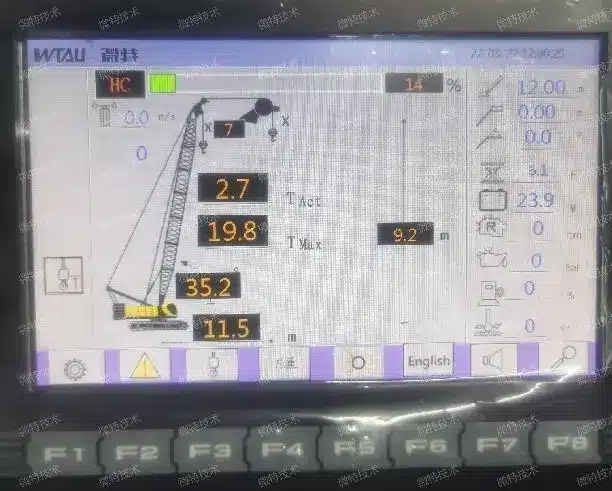
The core role of the crawler crane monitoring system is to grasp the operating parameters of the equipment in real time to help operators understand the load changes and equipment status during hoisting. Specific monitoring projects usually include the following aspects.
Lifting weight is one of the important parameters for the safe operation of crawler cranes. The system collects hoisting load data through the corresponding load sensor, and displays the real-time weight on the cab monitoring terminal.
During the hoisting process, the actual load will change with the weight of the hoisting object, the weight of the spreader and the operating state. Through lifting weight monitoring, the operator can keep abreast of the current lifting load and avoid exceeding the lifting weight range allowed by the equipment.
For large crawler cranes, lifting weight monitoring data is also an important basis for calculating the lifting moment and warning of overload.
The lifting moment is an important index that affects the stability and safe operation of crawler cranes.
Under the conditions of different working amplitudes, boom angles and hoisting loads, the corresponding allowable lifting weights of crawler cranes are not the same. Even if the lifting weight does not exceed the maximum lifting weight under a certain working condition, it is necessary to determine whether it is in the allowable working range based on the current working range and other parameters.
The monitoring system collects relevant data such as load and amplitude, combined with the corresponding operating condition parameters of the equipment and the rated lifting performance data, to judge the current lifting moment and its use status.
When the actual operating state is close to the set safety limit, the system can issue an early warning to remind the operator to pay attention to adjusting the hoisting working conditions.
Lifting height monitoring is mainly used to grasp the vertical operating position of the hook or hoisting object.
By installing the corresponding height detection device, the system can collect the operating data of the lifting mechanism in real time and display the current lifting height on the display terminal.
In actual construction, lifting height monitoring helps the operator control the lifting and descending process of the hoisting object, and the corresponding height limit and alarm function can also be set according to the equipment configuration.
The angle and working range of the boom are important parameters for the heavy lifting conditions of the crawler.
Boom angle monitoring is mainly used to obtain the inclination angle of the current boom, and the working amplitude reflects the horizontal distance between the centerline of the hook and the center of rotation of the crane.
As the angle and working range of the boom change, the rated lifting weight of the crawler crane will also change. Therefore, the system needs to combine the working condition data of the equipment to make a comprehensive judgment on the relevant parameters.
By monitoring the angle and working range of the boom in real time, the driver can more intuitively understand the current lifting conditions of the equipment.
Large crawler cranes are usually used in outdoor construction scenarios such as bridges, wind power, and large-scale infrastructure construction. Changes in on-site wind speed may have an impact on hoisting operations.
The system can collect on-site wind speed data through the wind speed sensor and display it on the cab display terminal.
When the wind speed reaches the early warning or restriction conditions specified by the equipment, the system can issue an alarm to remind the operator to take appropriate measures according to the requirements of the equipment and on-site conditions.
In addition to the load and hoisting condition parameters, the crawler crane monitoring system can also monitor the operating status of some equipment according to the actual configuration.
For example:
By collecting and displaying this information, it can help operators understand the operation of the equipment and provide a reference for the daily management and maintenance of the equipment.
The sensor is an important part of the crawler crane monitoring system to obtain on-site data, and its installation quality directly affects the accuracy and stability of data collection.
In the actual installation process, it is not only necessary to pay attention to whether the sensor can be wired and output signals normally, but also to consider the force direction, installation structure, fixing method and use environment of the sensor.
Especially for systems that use load cells for load measurement, irregular installation may lead to inaccurate measurement data and even cause damage to the sensor.

A load cell is a device that converts force or weight into an electrical signal output. Common resistance strain gauge load cells are mainly composed of elastomers, resistance strain gauges, compensation components and sealing materials.
The basic working principle is: when the sensor is subjected to an external load, the internal elastomer will undergo minor deformation, and the resistance strain gauge pasted on the elastomer will also undergo deformation, resulting in changes in the resistance value.
These resistance strain gauges usually form a Whiston bridge. By measuring the changes in the output signal of the bridge, an electrical signal corresponding to the external load is obtained.
The monitoring system collects and processes the output signal of the sensor, and after corresponding calibration and conversion, the actual load data can be obtained.
Therefore, the sensor not only needs to have a suitable range and accuracy, but its installation structure must also meet the normal force requirements.

When installing the load cell, it is necessary to ensure that its force direction meets the product design requirements.
For sensors that use vertical carrying mode, the sensor should be guaranteed to bear the load in the specified direction, and the force between the multiple sensors should be as uniform as possible.
If there is a significant partial load during the installation process, or there is an inclination between the sensor and the connecting structure, it may cause the sensor to withstand additional lateral forces.
This situation will not only affect the load measurement results, but may also cause problems such as slow data drift and reduced measurement accuracy.
Therefore, after the installation is completed, it is necessary to check the positional relationship between the sensor and the connecting parts to confirm that each force point meets the design requirements.
Lateral force and torque are the issues that need to be paid attention to during the installation of load cells.
Cause of lateral force:

Factors such as inaccurate installation position of the sensor, tilt of the connecting parts, and thermal expansion and contraction of the structure may all cause the sensor to be subjected to additional forces in the horizontal direction.
When the sensor is subjected to unnecessary lateral force, phenomena such as inaccurate weighing and slow movement of data may occur, affecting the measurement accuracy of the system.
Cause of torque:

If the installation structure is skewed, or the sensor installation position is not accurate, the sensor may be subjected to torsional load.
The torque will cause the internal force state of the sensor to change, and it will be in an unreasonable force state for a long time, which may also cause wear of the pressure bearing head, damage to the sensor, or even fracture.
Therefore, during installation, it should be important to check whether the connecting member is tilted, whether the force position is correct, and whether there is unreasonable mechanical interference between the sensor and the installation structure.

The sensor mounting surface and the mounting base should be kept horizontal to avoid obvious skew.
In a weighing system composed of multiple load cells, the level difference between the mounting surfaces of each sensor also needs to be controlled.
According to the installation training materials, for related multi-sensor weighing systems, the level difference between the mounting surfaces of each other should be less than 5mm; the training materials also point out that for systems with low measurement accuracy requirements, it can be appropriately relaxed when the corresponding conditions are met.
In addition, the mounting surface should be kept flat and smooth, and there should be no defects such as film, burrs, sharp points, etc. that affect contact and force.
If the mounting surface is uneven, the sensor may experience local force, tilt, or torsion, which in turn affects the measurement results. Long-term operation may also cause surface wear of bearing holes and connecting parts.
Therefore, the base should be inspected before installation, and cleaned and processed if necessary to ensure that the mounting surface meets the installation requirements of the sensor.
The sensor mounting base not only needs to ensure level and flatness, but also needs to have sufficient structural strength.
If the thickness of the base is insufficient, the structural stiffness is not enough, or the base area is less than the installation area required for the sensor, bending and deformation may occur after bearing the load.
Once the base is deformed, the actual force direction of the sensor may be changed, resulting in inaccurate measurement data.
In severe cases, it may also affect the normal operation of the sensor and connection structure, bringing safety risks.
Therefore, when installing, it is necessary to ensure that the base is firm and reliable, the installation area meets the requirements, and the strength of the base is checked according to the actual load and structural design.

The quality and fastening method of the mounting bolts will also affect the stability of the sensor.
According to the training materials, high-strength bolts should be used when installing sensors, such as grade 8.8, grade 10.9, etc. For sensors whose design requires gaskets to be installed, gaskets should be installed in accordance with the requirements.
Before the bolts are tightened, appropriate anti-rust and anti-jamming measures can be taken on the threaded parts according to the connection structure and product requirements.
At the same time, you need to pay attention to the following points:
If the bolt installation is not standardized, it may cause thread stretching, deformation, loose connection and other problems, affecting the measurement accuracy and service life of the sensor.

The junction box of the load cell is an important part of the signal connection and processing, and its installation environment will also affect the stability of the system operation.
After the sensor wiring is completed, the junction box should be checked, focusing on the following aspects:
First, for unused wiring holes on the junction box, matching plugs should be used to seal them to avoid dust and moisture from entering.
Second, check the fastening bolts on the upper cover of the junction box to avoid lax sealing due to loose bolts.
Third, choose the installation location of the junction box rationally, and try to avoid being in a location that is prone to stagnant water, moisture or external pollution for a long time.
If dust and moisture enter the junction box, it may cause the internal circuit board to be contaminated, and even cause changes in electrical parameters, irregular beating of monitoring data or drift up and down.
Therefore, after the wiring is completed, it is necessary to check the sealing of the junction box to ensure that the electrical connections and protective measures meet the design requirements.
The crawler crane monitoring system not only needs to collect and display data, but also analyzes the operating parameters of the equipment to help operators detect abnormal working conditions in a timely manner.
The basic workflow of the system can be divided into the following steps.
Through various sensors installed on the equipment, the system continuously collects data such as lifting weight, boom angle, working range, lifting height and wind speed.
Different sensors output corresponding signals according to their own working principles, and the data acquisition unit performs unified processing.
After the monitoring terminal receives the data uploaded by the sensor, it performs data conversion, working condition judgment and related parameter calculations based on the system configuration.
For example, the system can combine the current lifting weight, working range, and the rated lifting performance data corresponding to the equipment to judge the use status of the lifting torque.
According to the equipment safety requirements and the actual monitoring plan, corresponding early warning and alarm conditions can be set.
When the operating parameters of the equipment are close to the early warning value, the system reminds the operator to pay attention to the current working conditions; when the alarm conditions are reached, the system issues a warning through sound and light alarms.
The specific early warning threshold should be determined based on equipment technical data, applicable specifications and actual configuration, and a unified value cannot be simply used.
According to the system function configuration, the operating parameters and alarm information of the equipment can be recorded.
When an abnormal situation occurs in the equipment, management personnel can combine historical data to view the relevant operating status, which provides a basis for fault analysis, equipment maintenance and safety management.
Crawler cranes have strong hoisting capabilities and have a wide range of application scenarios. The requirements for equipment monitoring in different construction environments are also different.
Large-scale bridge engineering:
In the process of bridge construction, crawler cranes may undertake the lifting tasks of large steel structures, bridge components and construction equipment. The monitoring system can grasp the hoisting load and working range in real time, which helps to improve the safety management level of large-scale component hoisting operations.
Hoisting of wind power equipment:
Components such as fan towers, nacelles, and blades in wind power projects usually have larger sizes and weights, which require higher control of the working conditions of hoisting equipment. The crawler crane monitoring system can help operators master parameters such as load, boom angle and wind speed.
Petrochemical equipment installation:
In the construction of large-scale petrochemical projects, crawler cranes are often used for the installation of large-scale equipment, pipeline modules and steel structures. By monitoring the operating parameters of the equipment in real time, it can provide data support for complex hoisting operations.
Large-scale steel structure construction:
In the process of plant construction, venue construction and large-scale steel structure installation, crawler cranes need to continuously adjust the hoisting position and working range according to on-site conditions. The monitoring system can help operators grasp the operating conditions of the equipment.
For construction companies, the choice of crawler crane monitoring system cannot only depend on whether the equipment has display and alarm functions, but also needs to consider the monitoring accuracy, system stability, equipment adaptability, and later technical services comprehensively.
There are differences in the lifting capacity, structure and working methods of different types of crawler cranes.
When selecting a system, the parameters that need to be monitored should be determined based on the equipment model and actual construction conditions to avoid mismatches between the monitoring function and the actual use requirements.
Sensors are the basis of system data acquisition, and their measurement accuracy, environmental adaptability and long-term operating stability will affect the use effect of the entire monitoring system.
In addition to paying attention to the technical parameters of the sensor itself, attention should also be paid to the installation structure, force direction and on-site protective measures.
The monitoring system should be able to judge the relevant operating parameters based on the actual operating conditions of the equipment, and issue an alarm in time when the preset conditions are reached.
The alarm information should be clear and intuitive to facilitate the driver to understand abnormal conditions in a timely manner.
The crawler crane monitoring system involves sensor installation, electrical wiring, parameter calibration and system debugging.
Installers not only need to be familiar with the basic working principle of the sensor, but also need to understand the equipment structure and monitoring scheme to ensure that the sensor installation location, force method and signal connection meet the design requirements.
Crawler cranes usually undertake important hoisting tasks in large-scale engineering projects, and the stability of equipment operation directly affects the construction progress.
Therefore, when choosing a supplier, it is also necessary to pay attention to whether it has on-site installation, system debugging, troubleshooting and follow-up maintenance capabilities.
For long-term monitoring equipment, perfect technical support can help users solve problems encountered during system operation in a timely manner.
Next Article:
24-Hour Service Hotline: 0717-6922999 WeChat: 13972023522 Email: technical@wtauserver.com Address: No.6 Gangcheng Road, Yichang Area, China (Hubei) Pilot Free Trade Zone
Copyright © 2026 Wtau Technology Co., Ltd. All Rights Reserved. ICP License No.: E ICP 12004023-1