Lifting equipment such as bridge cranes, gantry cranes, tower cranes, metallurgical cranes, and port gate cranes operate at high frequencies for a long time. Hidden dangers such as overload, cable-stayed pulling, topping, collision, brake failure, and wire rope damage can easily cause capsizing, falling objects, and major casualties. Accidents. Relying on manual records and naked-eye control by drivers, it is difficult to keep complete operation data, trace hidden dangers, and meet the rigid requirements of the annual inspection of special equipment.
Crane safety monitoring and management systemLifting equipment such as bridge cranes, gantry cranes, tower cranes, metallurgical cranes, and port gate cranes operate at high frequencies for a long time. Hidden dangers such as overload, cable-stayed pulling, topping, collision, brake failure, and wire rope damage can easily cause capsizing, falling objects, and major casualties. Accidents. Relying on manual records and naked-eye control by drivers, it is difficult to keep complete operation data, trace hidden dangers, and meet the rigid requirements of the annual inspection of special equipment.
, Also often called lifting machinery safety monitoring and management system、
Crane safety monitoring system
, is an intelligent control facility for special equipment that is mandatory by the state to be configured. It collects the operation data of the whole machine through multiple types of sensors to achieve real-time early warning, full-process storage, and remote supervision.
Crane Safety Monitoring System,It is an intelligent management facility for special equipment mandated by national regulations. Multiple types of sensors collect overall equipment operation data to support real-time early warning, full-process data storage and remote supervision.
Equipment procurement, factory technical reform, and maintenance personnel will often search for crane safety monitoring and management system standards, national standards, and the latest national regulations, consult which hardware and modules are included in the crane safety monitoring and management system, and understand the crane safety monitoring and management system installation specifications. Focusing on the search needs of the whole network, this article systematically combs the system composition, national standard requirements, installation guidelines, and landing values, and adapts to new crane installations, old equipment retrofits, and special inspections.
1. National standard basis for crane safety monitoring and management system (national standards and latest regulations)
1. Core national standards
The current core implementation of the national standard:GB/T 28264-2017 "Safety Monitoring and Management System for Lifting Machinery", Is the general standard for the design, production, installation and acceptance of all lifting machinery monitoring systems, and is also the only basis for the inspection and judgment of special inspection institutes in various places. Different subdivided equipment (tower cranes, metallurgical cranes, port cranes) are superimposed with special supplementary requirements on the basis of the national standard.
2. Hard and fast requirements of the latest national regulations
- All bridge and gantry cranes, mobile cranes, tower cranes, and gantry cranes with a rated lifting weight greater than or equal to 3t must be equipped with a complete set of safety monitoring and management systems in accordance with specifications; metallurgical lifting molten metal cranes are the mandatory highest level of control, and the monitoring function must not be simplified.
- The system must have a local storage function that cannot be tampered with, and the operating records must be kept for a period of not less than 30 days; alarm records such as overload, limit actions, and illegal operations must be archived separately and cannot be deleted manually.
- The monitoring circuit needs to be independent of the lifting main control circuit, and cannot rely on the driving main control PLC to complete the protection to ensure that the monitoring is still effective in the event of a failure of the main control.
- Cranes that are not installed in accordance with standards, have missing system functions, or have failed storage will all be judged to be unqualified for annual inspection and required to be shut down for rectification.
2. What is included in the crane safety monitoring and management system (complete system composition)
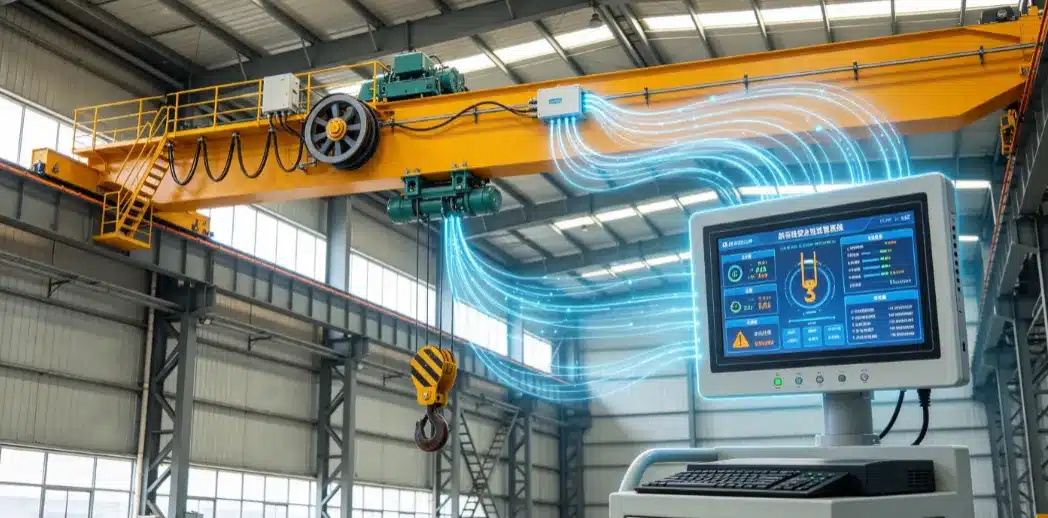
Many companies are not clear about the hardware and functional modules of the crane safety monitoring and management system. The entire system is divided into three layers: front-end sensor acquisition, local control cabinet, and remote monitoring platform, corresponding to the requirements of the whole process of lifting machinery safety monitoring and management.
(1) Front-end sensor acquisition hardware
- Load monitoring component: Weight sensor, real-time monitoring of lifting load, identification of overload and partial load;
- Travel limit sensor: Lifting upper and lower limits, travel limits for carts and trolleys, rotation limits, prevention and control of topping and collision of the whole machine;
- Attitude angle sensing: Luffing angle and inclination sensors, suitable for tower cranes and automobile cranes to calculate torque to prevent overturning;
- Brake and mechanism monitoring: Brake opening and closing detection, motor speed, reel operation monitoring, early warning of slip hook and brake failure;
- Wire rope flaw detection sensor: Optional, online detection of broken wire, wear, rust, and loose strands of wire rope;
- Environmental sensor: Wind speed sensor, mostly used for tower cranes and port cranes, high wind warning is prohibited for hoisting;
- Video camera: High-definition video recording of the cab, hook, and cart walking area, and full video recording.
(2) Local on-board control cabinet
The local host aggregates all sensor signals, and the screen displays the lifting weight, amplitude, location, operating speed, and fault information in real time; it has local hard disk storage, and all operation, alarm, and operation data are stored locally, and historical records are viewed on-site; sound and light alarms can be linked to limit dangerous actions when the hazard threshold is reached.
(3) Lifting machinery safety monitoring platform (remote cloud)
The data of multiple cranes is uniformly aggregated to the online management platform, and the computers and mobile phones of enterprise managers can remotely view the real-time status of all traffic in batches; weekly/monthly operation reports, fault statistics, and overload frequency accounts are automatically generated; abnormal SMS push is supported to realize centralized and remote control of lifting equipment in the factory.
3. Mainstream classification: What are the adaptable models of crane safety monitoring and management system?
According to the types of cranes, the systems on the market are divided into four categories, and the hardware configuration increases or decreases with working conditions.:
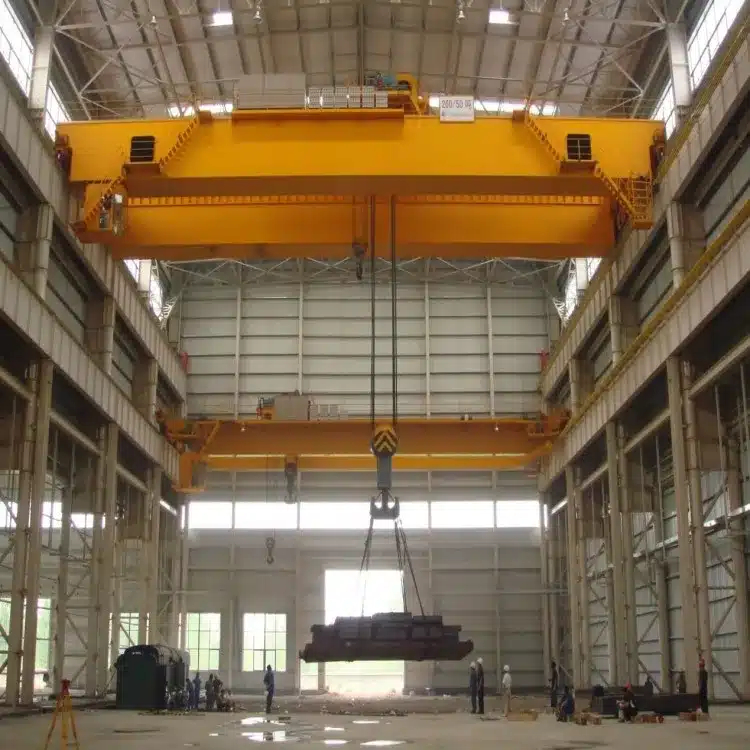
- Special monitoring system for bridge gantry crane: Focus on load, stroke, anti-collision, and lifting mechanism monitoring, which is suitable for ordinary driving in factories; metallurgical models add high temperature resistance, anti-high temperature cables, and motor temperature monitoring.
- Tower crane monitoring system: Standard torque, wind speed, rotation angle, and hook height monitoring to meet the compliance requirements of construction site tower cranes.
- Mobile crane (car crane, crawler crane) monitoring system: With torque limiting, luffing, and arm length monitoring as the core, it is suitable for multi-road hoisting in the wild.
- Port gate crane and container shore crane monitoring system: Increase moisture-proof and salt spray-proof hardware, increase anti-collision and monitoring of large vehicles, and adapt to the high-corrosion environment by the sea.
4. Crane safety monitoring and management system installation specifications and landing rules
If you want to successfully pass the special inspection, you must strictly follow the installation specifications of the crane safety monitoring and management system. The standardized construction requirements are as follows:
- The sensor point is firmly and reliably installed
The tension sensor is installed in the hook group and the lifting reel to set the position of the pulley; the angle sensor is fixed at the root of the boom; the limit switch is fixed at the end of the cart, trolley track, and lifting reel; all brackets are welded and fastened, and the sensor shall not be loose and displaced due to long-term vibration of the vehicle. The sensors in the metallurgical workshop are equipped with thermal insulation protection to resist thermal radiation.
- Wiring protection compliance
The signal line is made of shielded oil-resistant cables, which are routed along the bridge and through bellows. The cables avoid high temperature, friction, and heavy objects rolling areas; the terminal blocks are fastened and waterproof to reduce data transitions caused by electromagnetic interference. Multiple cables are classified and labeled to facilitate later maintenance.
- The installation location of the control cabinet is reasonable
The local monitoring host is installed in the cab with the driver's line of sight and the vibration is too small to facilitate the driver to view the data in real time; the protection level of the open-air and outdoor control cabinets is not lower than IP54, and the waterproof and dustproof cabinets of IP65 and above are selected for seaside and metallurgical environments.
- The wiring loops are independent and separated
The safety alarm, limit shutdown circuit and the driving main control circuit are physically isolated, and the sharing of lines is prohibited to prevent the main control failure from being connected to the monitoring failure.
- The installation is complete, the whole machine is calibrated and debugged
Use standard weights to calibrate the weight accuracy, and test the limit alarm, overload shutdown, and wind speed warning functions one by one; verify that the local storage and video recording functions are normal, and keep the debugging record table for special inspection and reporting.
5. The core points of inspection of crane monitoring system standards
The special inspectors checked item by item against the crane monitoring system standards, focusing on the acceptance of the following:
- There are no defects in the full set of monitoring functions, and all monitoring items corresponding to the requirements of the national standard are fully equipped.;
- The weight and torque errors are within the allowable range of the national standard, and the calibration can be traced;
- The data is stored completely, the storage time is up to the target, and the records cannot be deleted or tampered with.;
- The logic of the alarm action is accurate, and the overload and limit do not rely on cutting off dangerous actions.;
- The wiring, protection, and installation are in line with on-site working conditions, and there are hidden dangers of wireless circuit aging and sensor bumps.
6. The multiple values of deploying a crane safety monitoring and management system
- Meet mandatory compliance and successfully pass the annual inspection
Keep up with the national standards for crane safety monitoring systems and the latest national regulations, and complete a complete set of systems can pass regular inspections of special equipment at once to avoid safety supervision penalties and the risk of shutdown and rectification.
- Front prevention and control of lifting safety accidents
All-dimensional monitoring of various risks such as overload, slip hooks, collisions, and high wind operations, early warning and active locking of dangerous operations, greatly reducing the probability of hoisting falling objects, equipment overturning, and labor injuries.
- Realize job traceability and standardize personnel operations
Hoisting data and videos are kept throughout the process, and all overloading, savage cable-stayed pulling, and illegal limit shielding are all recorded to facilitate management personnel to hold them accountable and rectify them, and restrain drivers from operating irregularly. In the event of an accident, a complete record can be used as an important certificate for the traceability of the accident.
- Intelligent centralized management to reduce operation and maintenance costs
Multiple cranes are connected to the lifting machinery safety monitoring platform, so managers do not need to travel to and from various workshops for on-site inspections, and remotely grasp the operating status of all equipment; rely on fault data to accurately locate aging parts, planned maintenance, and reduce sudden failures and shutdowns.
7, summary
The crane safety monitoring and management system is a statutory necessary safety facility for lifting equipment
The on-site renovation is carried out in strict accordance with the installation specifications of the crane safety monitoring and management system to ensure that the wiring, sensors, and control cabinets are installed to standard standards. Whether it is a factory crane, a construction site tower crane, a port crane, or a metallurgical casting crane, the construction of a compliance monitoring system can not only maintain the bottom line of hoisting safety, but also meet the requirements of national supervision, and realize the integrated control of lifting equipment safety, operation and maintenance, and digitization.