Introduction
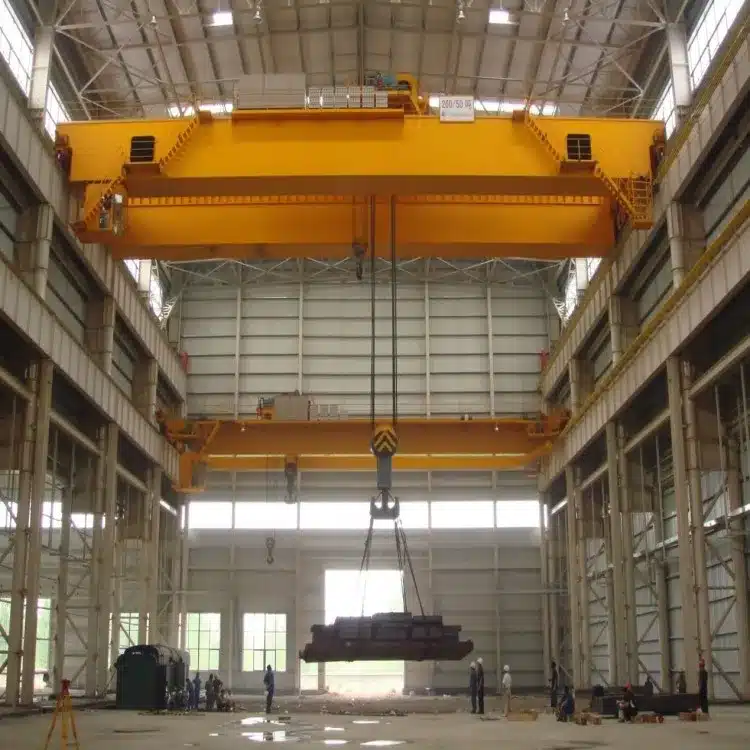
Metallurgical casting cranes are special equipment with the highest risk and heaviest assets in the core process of steel smelting. Taking the most common 280-ton converter feeding and steel-out span casting crane as an example, it has long been under extremely harsh working conditions of 1600 degrees Celsius molten steel radiation, strong electromagnetic interference, severe mechanical vibration and high concentration of graphite dust.
In order to strictly meet the strict requirements of national standards for the safety monitoring and management system of lifting machinery, and realize the transition from independent emergency repair to pre-predictive maintenance, this technical solution is aimed at 280-ton metallurgical cranes, from the aspects of system architecture, sensor configuration, high temperature resistant intelligent video surveillance, network anti-interference and specification compliance.Carry out in-depth design.
1. The core functions and overall architecture of the system
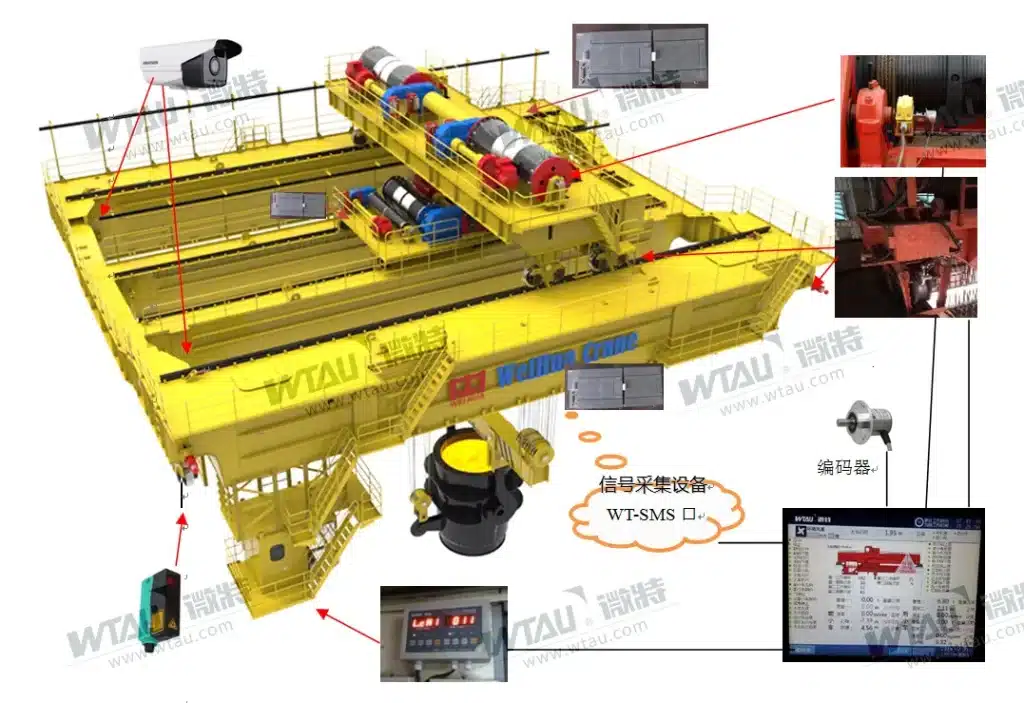
The system adopts an industrial-grade programmable logic controller (PLC) as the main control core, integrates an artificial intelligence (AI) edge computing gateway to process visual data, and configures an industrial-grade car video recorder for full-time data storage.
The system is spatially divided into four hierarchical structures as a whole:
- Data acquisition layer: Responsible for the data summary of front-end sensors and cameras.
- Network transport layer: Responsible for the construction of anti-interference signal link.
- Perceptual control layer: Mainly located in the driver's room, it provides a human-computer interaction interface.
- Remote management platform: Located in the ground dispatching center, it is connected to the information system of the steel mill.
The system design has a high degree of independence and security.The failure of the monitoring system itself will never affect the normal operation of the crane's main control system, To ensure the safety of operation in extreme conditions.
The core application functions of the system mainly cover three directions:
- Industrial black box function: The system has power-off protection and independent storage, and records core parameters such as lifting weight, height, and stroke in real time. The system supports up to 30 days of local cycle traceability, which is used for early warning of overrun, self-inspection of faults, and determination of accident liability.
- Three-dimensional precise alignment and visualization: The system integrates image enhancement technology with three-dimensional positioning algorithm. The algorithm filters out the screen jitter caused by high temperature and heat waves, and realizes the automatic tracking and accurate bag hanging of the gantry hook and the trunnion of the ladle.
- Safety interlocking and predictive maintenance: The system integrates overload restriction, mechanism anti-collision, main beam structure fatigue assessment, wire rope nondestructive flaw detection and driver fatigue driving monitoring to build an active defense network in all directions.
2. Detailed plan for sensor configuration
In view of the high-risk nature of the 280-ton casting crane, the sensor configuration fully covers the four core dimensions of safety load, operating mechanism, metal structure, and electrical power, and the key channels are all designed with dual redundancy.
- Main lifting load monitoring
- Selection: Bearing seat type load cell. The range is 150 tons, and the accuracy is plus or minus 0.5%.
- configuration: A total of 4 are installed. They are arranged under the four fixed bearing seats of the two reels of the main hoist mechanism.
- effect:: The total weight of molten steel is calculated by a combination of 4 sensors. At the same time, it has the functions of partial load, overload, and unbalanced alarm.
- Auxiliary lifting load monitoring
- Selection: Pin-type load cell. The range is 40 tons, the accuracy is plus or minus one percent, and the internal integrated signal amplifier.
- configuration: A total of 2 are installed. Replace the fixed pulley shafts of the secondary hoist and the three hooks respectively.
- effect:: Perform non-contact shear force measurement to ensure that the auxiliary spreader is operating within a safe load.
- Main lifting height monitoring
- Selection: Heavy-duty absolute encoder. The interface adopts a universal bus, with a protection level of industrial IP67, and a shockproof spring bracket.
- configuration: A total of 2 units are installed, using dual redundant configurations.
- effect:: 1 unit is installed at the non-axial extension end of the main hoist motor, and 1 unit is installed at the high-speed shaft end of the main reducer. The two-channel height data check each other in real time to prevent the mechanical coupling from breaking and the height limit from failing.
- Cart and trolley stroke monitoring
- Selection: Industrial-grade infrared laser rangefinder. The range is between 0.2 meters and 150 meters, with an accuracy of plus or minus 2 mm, and an electric heating anti-condensation and dust cover.
- configuration: A total of 3 units were installed.
- effect:: 1 unit is responsible for the travel of the trolley, installed on the side of the trolley frame and aligned with the reflector at the end of the main beam. The two sets are responsible for the travel of the cart, which are installed on the double-sided end beams and aligned at the end of the track of the plant. They are used for automatic correction and anti-collision interlocking of the cart.
- Stress monitoring of main beam structure
- Selection: High temperature vibrating string strain gauge. The range reaches plus or minus 1500 micro strains, and the operating temperature can withstand 150 degrees Celsius.
- configuration: A total of 4 are installed.
- effect:: Welded or pasted on the lower flange plate of the middle cross-section of the main beam, as well as the rigid node connected between the main beam and the end beam. The system calculates the bending stress of the main beam in real time and evaluates the residual life of the main beam.
- Condition monitoring of main wire rope
- Selection: Online detector of magnetic leakage wire rope. The applicable rope diameter is between 40 mm and 50 mm, and the missed detection rate of broken wire is zero.
- configuration: A total of 2 sets are installed.
- effect:: Fixed at the rope outlet on the opposite side of the two reels of the main hoist, the wire rope dynamically passes through the flaw detection ring to detect internal broken wires, wear and corrosion defects online.
- Condition monitoring of power mechanism
- Selection: Platinum resistance temperature sensor and integrated vibration transmitter. The temperature range is up to 200 degrees Celsius, and the vibration range is up to 20 millimeters per second.
- configuration: 4 sets are installed in each part.
- effect:: Mounted on the bearing housings at both ends of the main lifting motor, the input and output bearing housings of the main reducer. It is used to monitor motor overheating, mechanical fatigue and brake slippage.
3. Detailed video surveillance configuration plan
Video surveillance adopts a combination of fixed-point monitoring and intelligent visual tracking. In view of the infrared thermal radiation of hundreds of degrees directly facing the ladle at the bottom of the trolley, the camera at the key point must have physical thermal insulation and intelligent photoelectric processing capabilities.
- Point 1: Visualization of gantry hook and ladle trunnion (absolute core point)
- Layout: A total of 2 sets are set up. It is installed symmetrically at the bottom of the small rack, looking down vertically at the hook and the trunnion of the large package.
- Selection: Metallurgical special heavy-duty integrated PTZ camera. It has the characteristics of 4 million pixels, ultra-wide dynamic intensity, strong light suppression and ultra-low illumination.
- Technical requirements: The hardware must be equipped with a double-layer stainless steel water-cooled aerated blowing protective cover. Continuous access to compressed air and circulating cooling water to ensure continuous operation in an environment above 100 degrees Celsius. The windows are made of high-purity and high-temperature-resistant quartz glass to prevent the picture from turning white caused by strong light.
- Point 2: The front and track of the cart are running
- Layout: A total of 4 sets are set up. It is installed on the four corners of the beams at both ends of the cart and looks at each other in the direction of the track.
- Selection: Anti-vibration infrared high-definition gun camera. The camera has 4 million pixels and has a vibration resistance level of 5G.
- Technical requirements: Configure electronic anti-shake function. Algorithms are used to eliminate the violent shaking of the cart when braking and starting, and are used to monitor the safe distance between the track obstacles and the two vehicles.
- Point 3: Hoist and brake area
- Layout: A total of 2 sets are set up. It is installed on the top of the trolley rack and is aligned with the main and auxiliary reel ropes and braking areas respectively.
- Selection: Industrial dustproof gun camera. It has 4 million pixels and comes with a remote control wiper function.
- Technical requirements: Specially used to regularly remove viscous oil dust from the volatilization of graphite lubricants. The driver can observe whether there is a messy rope, smoke from the brake or slippage through the screen.
- Point 4: Inside the driver's room
- Layout: A total of 1 set is set. Installed in the front corner of the top of the cab, aimed at the driver's operating surface.
- Selection: Artificial intelligence (AI) smart car dome camera. Built-in high-computing-power AI chip, and integrated driver condition monitoring algorithm.
- Technical requirements: Automatically identify violations and fatigue behaviors such as drivers taking off work, smoking, answering the phone, and napping with their eyes closed. The system uses the hardware's built-in speaker to make voice alarms directly in the driver's ears.
- Point 5: Inside the electrical room
- Layout: A total of 2 sets are set up. Installed in the passage of the electrical room, aligned with the high and low voltage control cabinet or inverter cabinet.
- Selection: Ordinary industrial-grade infrared dome camera.
- Technical requirements: All-weather inspection of the electrical status of equipment, mainly used for fire monitoring of equipment.
- Video AI Intelligent analysis Gateway (program highlights improved)
- System composition: A 4-way artificial intelligence edge computing gateway is independently configured in the electrical room.
- Core algorithm: The system accesses the two main hook screens, and realizes the precise alignment and guidance of the gantry hook through the AI algorithm.
- Picture presentation: On the 15-inch industrial display screen in the driver's cab, the system automatically superimposes three-dimensional alignment auxiliary crosshairs. When the hook is precisely aligned with the ladle trunnion, the crosshair changes from red to green. This can assist drivers to accurately hang up their bags when there is strong smoke and dust and poor line of sight, greatly reducing the risk of collision.
4. Design of transmission, anti-interference and electrical safety
- Electrical isolation and power supply safety
- The system must be equipped with an independent isolated power supply, uninterruptible power supply (UPS), to ensure that the system can still last for 30 minutes after a power failure.
- The signal cable of the sensor is prohibited from being laid in the same slot as the power line of the crane's main motor.
- The cable must be made of double-layer shielded industrial bus cables, and be slotted and layered to avoid when routing, with a spacing of not less than 200 mm, or laid through heat-insulating shielded metal pipes throughout the process.
- Video transmission link design
- The trolley to cart section runs with the mobile towline, and the cable adopts a special high-flexible shielded network cable for the towline.
- The distance from the cart to the ground and the main control room is long, and optical fiber is preferred for long-distance transmission.
- This design can completely cut off the electromagnetic harmonic interference generated by the high-power inverter in the field.
- Physical protection and water and gas linkage interlocking
- For exposed load cells and height encoders, mechanical limit baffles and stainless steel heat shields must be designed to prevent direct molten steel radiation.
- The water-cooled video system must be equipped with a water flow switch and a temperature sensor in the water inlet pipe of the trolley.
- Once the cooling water is cut off at the scene, or the water inlet temperature exceeds 55 degrees Celsius, the system will immediately pop up a visual alarm of the video cooling system failure in the driver's cab and the ground master control, prompting process maintenance to prevent the burning of high-value lenses.
- Ground vehicle wireless network interconnection
- Local video and data are distributed and stored through industrial-grade car video recorders. The hard disk of the chassis has been physically reinforced with anti-vibration, and the data can be stored cyclically for 30 days.
- The video recorder provides a fiber-optic ethernet interface to the outside world, and transmits weighing, stress, limit and other data to the steel mill master control and dispatching center in real time through the vehicle-to-ground wireless ground base station on the roof of the car or the 5G factory private network.
- In the end, the equipment will be seamlessly integrated into the whole process supervision system of the production execution system (MES) of the smart factory.
Related reading:
Metallurgical crane safety monitoring system technical Solutions and industry practices https://www.wtauserver.com/metallurgical-overhead-crane-safety-monitoring-solution/