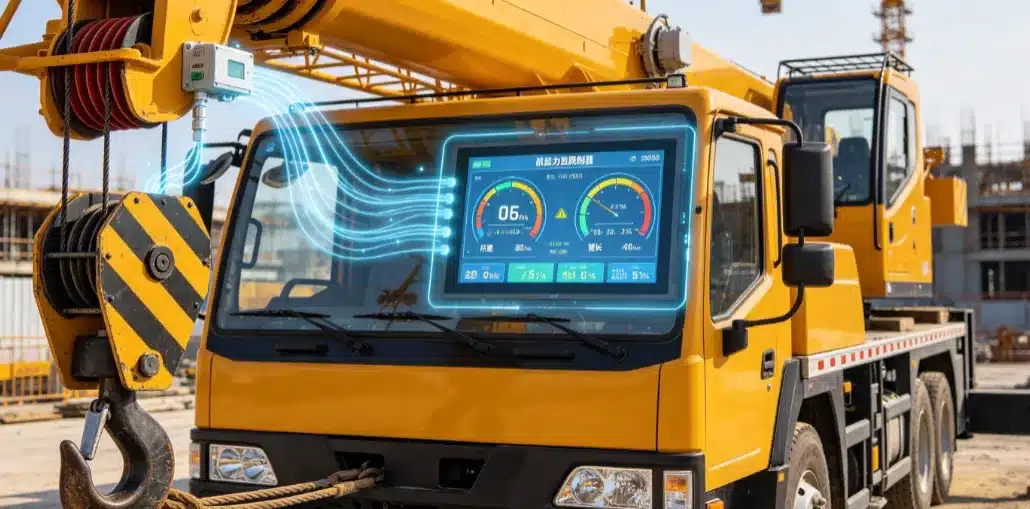
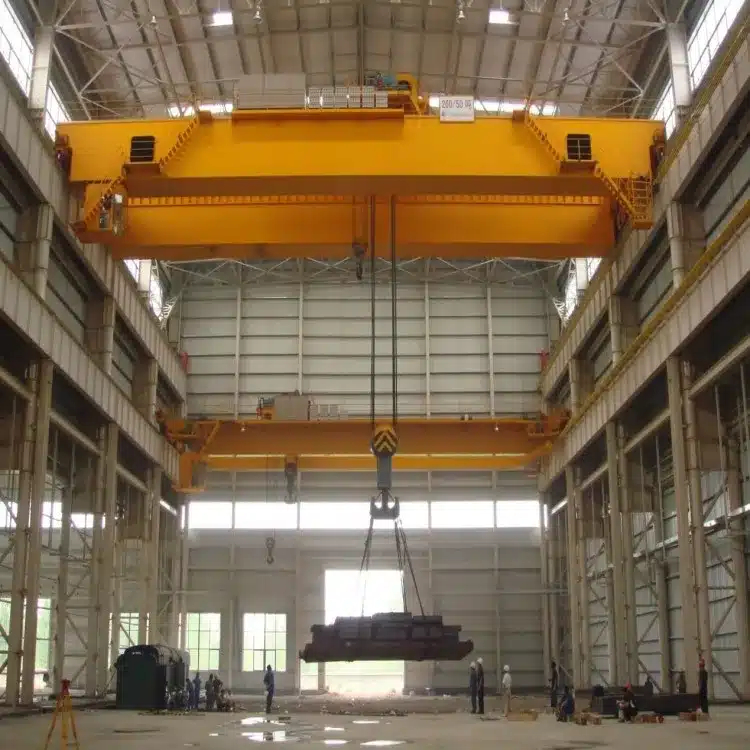
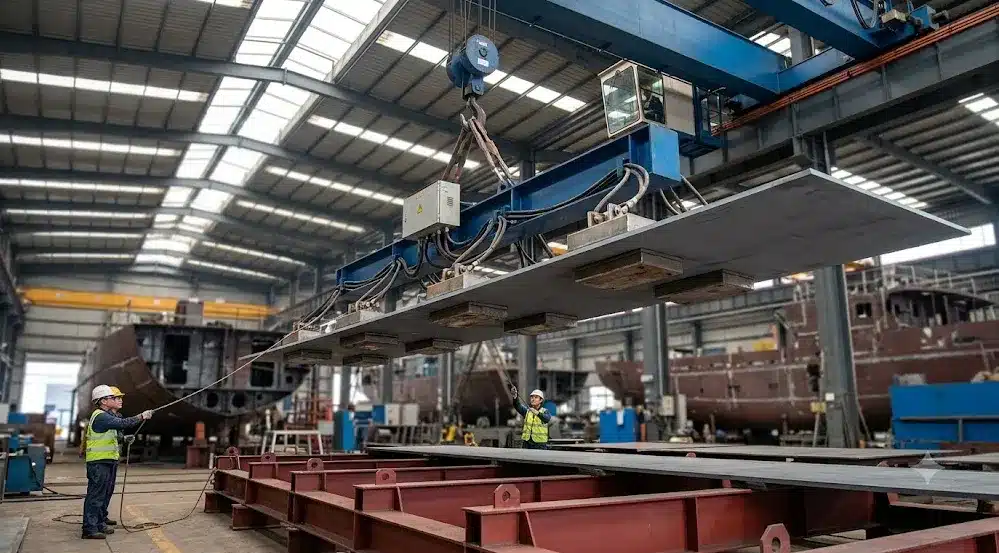
Automobile cranes, crawler cranes, port gate cranes, tower cranes, marine cranes and other types of variable-amplitude lifting equipment, the operating radius and boom length continue to change, and the overturning torque of the whole machine varies greatly for goods of the same weight at different amplitudes. Relying only on the driver's experience to judge the load, it is extremely prone to overload and cable-stayed overload, which can cause major safety accidents such as boom bending, overturning of the whole machine, and wire rope breaking. Crane torque limiter is a statutory necessary safety protection device for mobile and luffing cranes. It calculates the lifting torque in real time, classifies early warnings, restricts dangerous operations, and meets the rigid requirements of the annual inspection of special equipment.
Purchasing, maintenance and operating personnel frequently look up various safety parameters of load moment indicators. Combined with popular search terms, this article comprehensively explains working principles, action criteria, accuracy requirements, anti-side-pull performance and scrapping specifications to facilitate crane model selection, annual inspection, routine maintenance and commissioning.
1. The role of crane torque limiter (explanation of core functions)
Many front-line personnel can't tell the difference between load limit and torque limit. The main function of the crane torque limiter isComprehensively control the torque product of weight, amplitude, and arm length, Instead of just controlling a single weight.
- Collect lifting weight, boom length, and luffing angle in real time, automatically calculate the real-time overturning torque, and compare the rated torque curve of the equipment to determine the current operating safety margin.
- Hierarchical safety control: sound and light early warning of approaching rated torque reminds the driver; torque exceeds the standard and automatically locks the action in the dangerous direction, retaining the right to operate in the safe direction.
- Record operation data such as overload and illegal cable-stayed pulling, and keep the operation ledger intact to facilitate safe traceability and special inspection and verification.
- Targeted identification of the additional lateral torque caused by the lateral oblique pull of the hook, to make up for the shortcomings of the ordinary weight limit that cannot protect the oblique pull.
Simply put: the weight is heavy, but the amplitude is too large, it will still capsize. The torque limiter can avoid this kind of hidden overload risk under all working conditions, and it is an irreplaceable safety line of defense for luffing cranes.
2. The action rules of the crane torque limiter: How can the load move after overload?
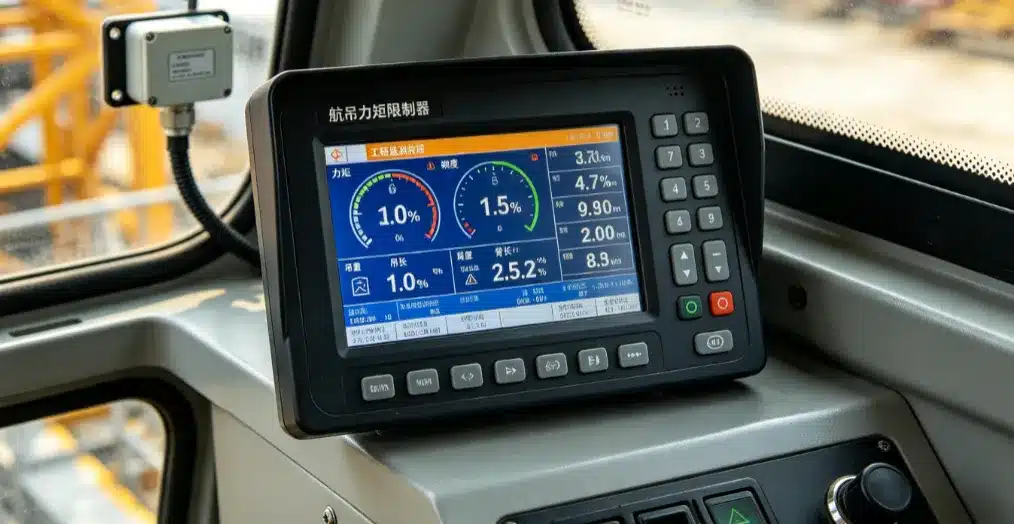
1. The threshold value of the load cut-off action that triggers the protection
Unified requirements of the national standard: When the actual torque reaches 90% of the rated torque, the equipment initiates sound and light pre-warning to remind the driver to reduce the amplitude and reduce the load.;
When the torque reaches 105% of the rated torque, the torque limiter forcibly cuts off the dangerous action circuit, that is, the load of the crane torque limiter reaches 105% of the rated torque to perform the cutting action.
2. When the crane torque limiter is in action, the allowable range of action of the load
After the protection is triggered, the system
Only operations that exacerbate danger are prohibited, Will not all lock the whole machine:
Safe actions are allowed: the hook drops, the boom retracts (reduces the amplitude), and the boom retracts and becomes shorter.;
Prohibit dangerous actions: the boom changes outward, the boom extends, and the crane continues to lift.
This logic ensures that the driver can safely drop the hook and close his arms when it is overloaded, and put the heavy object on the ground, so that there will be no dangerous situation where the hanging object is stuck and cannot be lowered.
3. The protection ability of the crane torque limiter to pull heavy objects sideways and obliquely on the hook
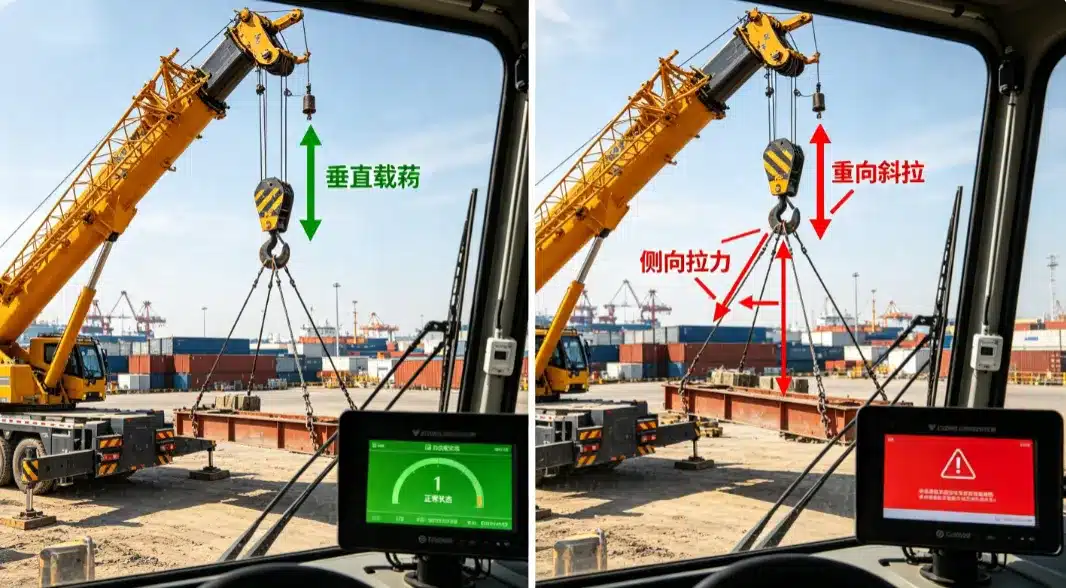
Conventional simple torque limiters only monitor vertical loads and cannot recognize cable-stayed pull; the new crane torque limiter is equipped with a lateral tension sensing module, which is specially designed to deal with the working conditions of hooks pulling heavy objects sideways and obliquely.
- The cable-stayed pull will produce a transverse force, which additionally increases the overturning torque of the whole machine, and at the same time pulls the boom and wire rope to cause structural damage; the torque limiter with cable-stayed detection can capture the transverse tension and convert it into an equivalent overturning torque.
- If the lateral tension exceeds the standard, the equipment directly warns and restricts the rotation and luffing actions, and it is forbidden to continue hoisting with cable-stayed pull; old torque limiters without cable-stayed pull function are strictly prohibited for long-term use in working conditions where there is frequent cable-stayed pull.
- The manual clearly states: the equipment is only used as a protective pocket bottom, and it is strictly prohibited to deliberately cable-stayed and crooked for a long time. Cable-stayed is an illegal operation and cannot rely entirely on the equipment pocket bottom.
4. Accuracy control: crane torque limiter error specification and scrap standard
1. Allowable accuracy: the error of the crane torque limiter is not greater than the national standard limit
According to the inspection specifications of lifting equipment, the comprehensive display error of the torque limiter shall not be greater than ±5%; the error interval of the action protection is ±5% of the rated torque. If the normal check value falls within the range, it is qualified and can be used normally.
2. Scrap determination: When the comprehensive error of the crane torque limiter is greater than, it will be scrapped.
After repeated calibration of weights, the comprehensive error of the equipment
Exceeding ±10%, And the accuracy cannot be repaired by calibrating or replacing the sensor, and it must be scrapped and replaced as a whole.
In addition, the shell is damaged by water ingress, contact ablation, the screen is not displayed, the sensor is stuck and fails, and the line is aging and cannot be repaired. Even if the error is qualified, the complete set of devices needs to be replaced.
5. The core use and debugging points of the crane torque limiter manual
Whether it is an automobile crane torque limiter, crawler crane, or marine crane model, the general core content of the crane torque limiter manual is divided into 4 pieces.:
- Working condition switching: When replacing the main arm, installing the auxiliary arm, or changing the counterweight, the corresponding working condition curve must be selected on the main machine. The wrong curve selection will directly cause the torque calculation error and the protection will fail.
- Regular calibration: It is stipulated to use standard weights for floor calibration before semi-annual / annual inspections to eliminate accuracy drift caused by sensor wear and cable aging.
- Prohibit shorting: The manual clearly prohibits artificially shortening the torque limiter circuit. Shortening is a major violation, and full responsibility is required in the event of an accident.
- Environmental maintenance: Outdoor, seaside, and steel mill equipment regularly make the sensors waterproof, salt spray, and dustproof to avoid inaccurate signals caused by dust corrosion.
6. The classification of mainstream models and the picture reference distinction of crane torque limiter
Comparing the pictures of crane torque limiters, the equipment on the market is divided into three categories, which are suitable for different cranes.:
- Integrated torque limiter for automobile crane: Cab LCD screen + arm angle and tension sensor, simple circuit, suitable for wheeled truck crane;
- Torque limiter for crawler crane: Support multi-curve switching of ultra-long main arm and ultra-starting working conditions, and stronger anti-vibration ability;
- Port / marine crane anti-corrosion torque limiter: All stainless steel sensors, anti-salt spray, and a lateral oblique pull detection module are added, which is suitable for wharf and offshore hoisting.
- Crane torque limit model: Please click here for detailshttps://www.wtauserver.com/product-center/related-products/load-moment-limiter/
7. Precautions for daily inspection of installation and verification
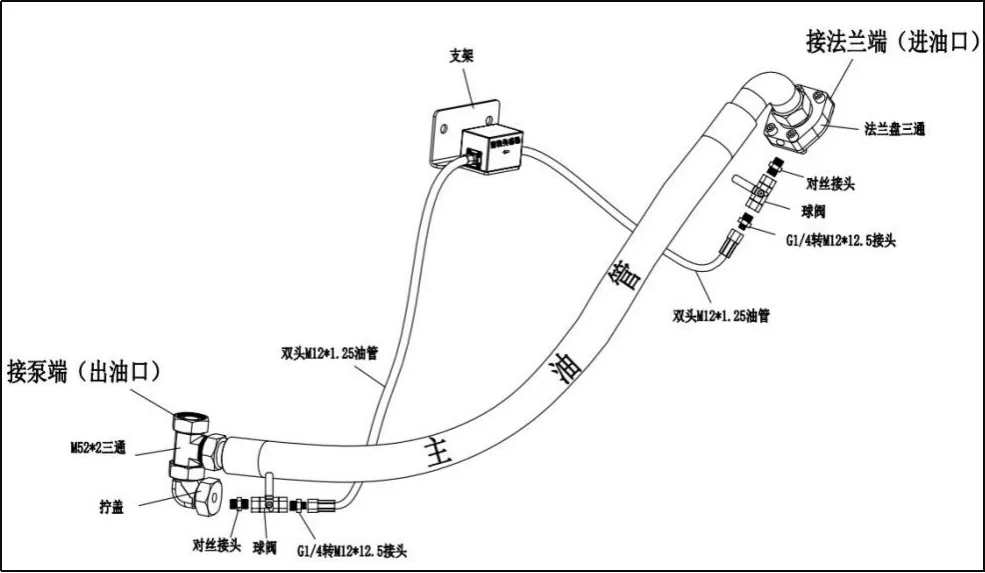
- The tension sensor is fixed at the position of the hook pulley and the luffing rod, the angle sensor is fixed at the root of the boom, and the mounting bracket is firm and non-deformed to avoid the displacement of the sensor caused by vibration.
- The torque curve must be recalibrated after each season change and overhaul;
- System self-inspection must be performed for daily boot-up, and self-inspection errors are prohibited for hoisting operations.;
- Do a good job of cable protection for outdoor equipment to avoid sun wear and rain soaking.
8. Summary
Crane torque limiter is the core safety accessory of luffing crane, relying on comprehensive torque calculation to solve the problem of incomplete control of simple weighing limit. Keep in mind when using: 90% early warning, 105% forced cut-off of dangerous actions; after the protection takes effect, you can only drop the hook and close your arms, and it is forbidden to continue to raise your arms and stretch your arms.
Check side pull detection capability during model selection and strictly control precision: normal error shall not exceed ±5%. Units with overall error exceeding ±10% that cannot be calibrated must be scrapped. Perform regular calibration with standard weights per the manual, and do not bypass or disable protective functions.
Standardizing the use of torque limiters can not only avoid overload and overturning safety accidents, but also meet the requirements of regular inspection of special equipment. It is a prerequisite for the compliance operation of lifting and hoisting on construction sites, ports, and factories.