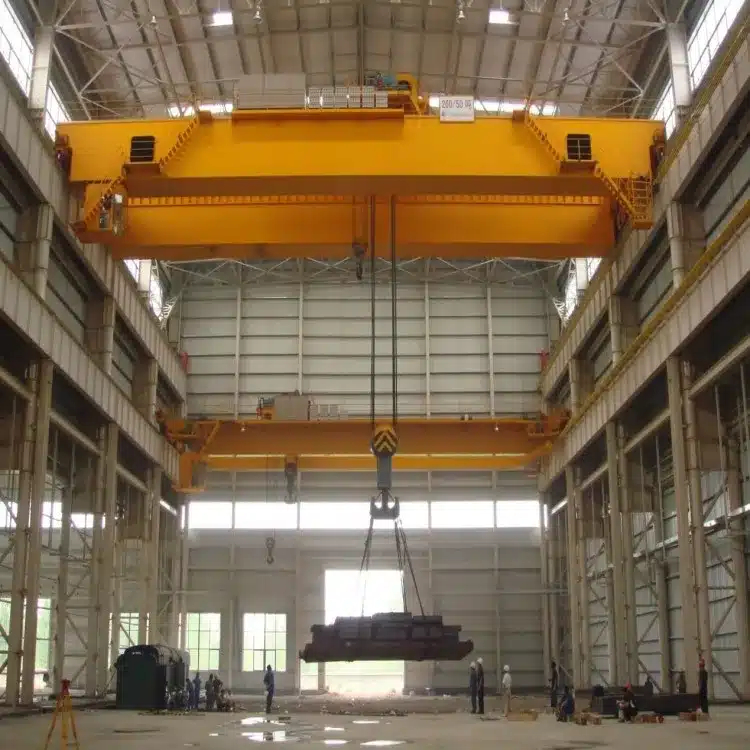
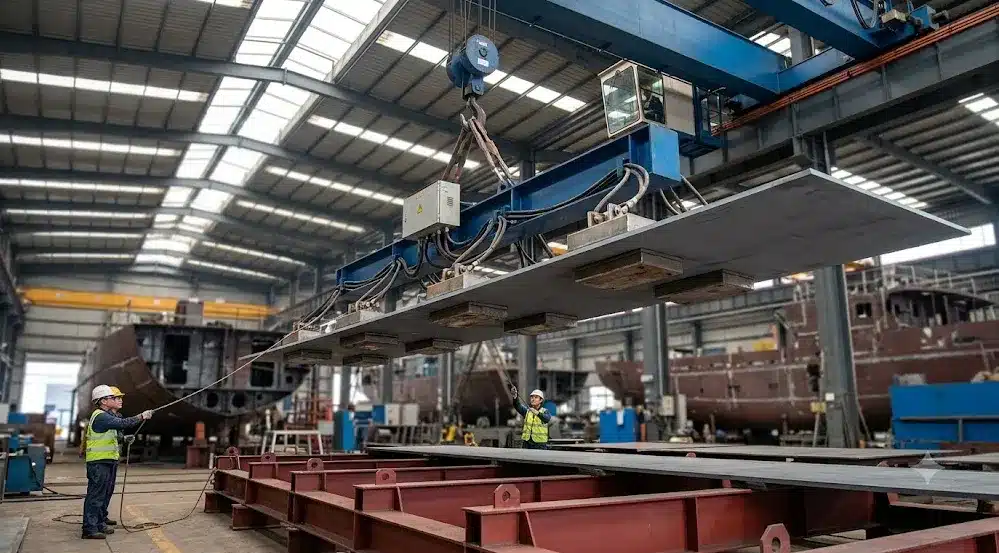
In machining workshops, steel structure factories, and warehouses, a large number of bridge lifting vehicles are arranged on the same track in parallel. Multiple vehicles cross-operate and shuttle back and forth, and it is easy for large vehicles to collide with each other. In the event of a collision, the light weight will cause deformation of the main beam of the vehicle, damage to the wheels, and gnawing on the track. The heavy weight will cause the crane to fall and the production line to be shut down, which will bring huge property damage and personal safety risks.
The traditional control mode relies on visual avoidance by driving drivers and on-site command by ground safety personnel. Long-term operations are prone to fatigue and negligence, and the supervision blind spot is even more prominent when the light is insufficient and the line of sight is blocked. The anti-collision protection device for lifting vehicles is also often referred to as the anti-collision device for bridge cranes, the anti-collision device for cranes, and the anti-collision system for cranes. It is a safety protection equipment specially developed for multi-machine operation on the same track. It relies on ranging and sensing technology to realize active early warning and braking protection, and fills the loopholes in manual supervision. It is also a protective facility for the standardization and transformation of workshop traffic safety and the key verification of the annual inspection of special equipment. Combined with users' high-frequency search questions, the following comprehensively explains the relevant knowledge of anti-collision protection devices for lifting vehicles.
1. The role of anti-collision protection device for lifting vehicles
Many factory managers will wonder, the workshop has already installed track buffers, do you still need to install anti-collision protection devices for lifting vehicles? There is an essential difference in the logic of the two. The buffer is a post-mortem mechanical buffer, which can only reduce the impact of the impact and cannot avoid collisions; the anti-collision protection device for lifting vehicles is an active protective equipment that can intervene in dangerous working conditions in advance.
The anti-collision protection device for lifting vehicles can monitor the relative distance between two adjacent vehicles in real time, and the system divides multi-layer safety zones. When the two vehicles enter the warning distance range, the equipment activates sound and light alarms to remind the drivers to slow down and avoid in time. If the vehicle continues to approach, the system automatically limits the operating speed of the cart; when the critical safe distance is reached, it directly locks the opposite direction of travel to prevent the two cars from colliding at the source.
In addition to machine-to-machine collision prevention, the complete set of devices can also monitor the distance between the driving vehicle and the plant column and the wall at the end of the track to prevent the driving vehicle from rushing the track and hitting the building. Long-term use can effectively protect the main beam, wheels, and track structure of the vehicle, reduce equipment maintenance costs, standardize the order of hoisting operations, and meet the compliance requirements of safety supervision inspections and annual inspections of special equipment.
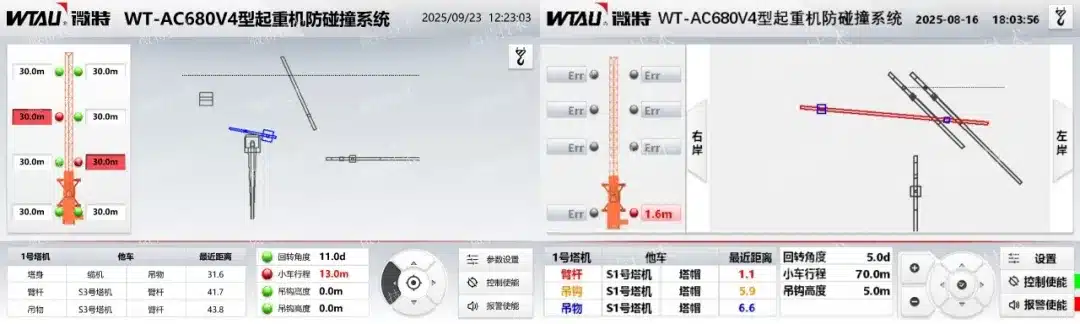
Wtau Anti-Collision System Integrated Solutions: UWB, Laser, 3D Spatial.
2. What are the anti-collision protection devices for lifting vehicles? Introduction to common types
There are a wide range of anti-collision protection devices for lifting vehicles on the market. According to the different ranging principles, the mainstream is divided into three categories: infrared, laser, and microwave radar. That is, the industry often refers to bridge crane anti-collision devices, which are adapted to different workshop working conditions.
The infrared anti-collision protection device for lifting vehicles has a simple structure and high cost performance, and relies on infrared photoelectric signals to achieve mutual recognition. It is suitable for ordinary processing workshops with less dust and clean space. The disadvantage is that it is easy to block the signal when encountering strong light, heavy dust, and water vapor, which interferes with the monitoring accuracy.
The laser-type crane anti-collision device has high ranging accuracy, fast response speed, flexible distance setting, and can accurately control the protection range. It is suitable for large-scale workshops with large spans and densely arranged multiple vehicles. When using, it is necessary to pay attention to the on-site hoisting materials and not block the laser optical path for a long time to avoid short-term failure.
The microwave radar anti-collision system has the strongest anti-interference ability, is not affected by dust, light, and fog, and has excellent penetration. The radar-type crane anti-collision system is preferred in dust-prone, high-temperature and harsh working conditions such as metallurgical workshops and foundries, which has stable operation and lower failure rates.
In addition, according to the control method, it is divided into stand-alone simple alarm model and linkage control cabinet integrated system. The simple model only realizes sound and light early warning; the integrated anti-collision system can be directly connected to the original electronic control circuit of the vehicle to achieve automatic deceleration and forced shutdown, with a higher level of safety protection.
3. Installation points of anti-collision protection device for lifting vehicles
When many factories install anti-collision devices for bridge cranes, the protective effect is greatly reduced because of the unreasonable installation location. The sensor is generally installed in the middle of the beam at both ends of the trolley, to ensure that the two probes of the trolley can send and receive signals directly to each other.
The installation height avoids the shading areas of spreaders, cables, and materials, and the wiring is shielded and protected, away from strong electromagnetic equipment such as frequency converters, and signal interference is reduced. During the commissioning phase of the device, the early warning distance, deceleration distance, and braking distance shall be reasonably set in accordance with the actual driving and operating space of the workshop, and fixed parameters cannot be uniformly applied.
The transformation of old-fashioned vehicles does not require large-scale changes to the original electronic control circuit. Most anti-collision protection devices can be connected to the control circuit by passive contacts. The construction cycle is short and does not affect the normal production of the workshop. After the installation is completed, it is necessary to simulate the driving conditions of the two vehicles facing each other multiple times, complete the entire process of alarm, deceleration, and shutdown, and confirm that the function is stable before it can be officially put into use.
4. Easy to confuse: the distinction between driving anti-collision devices and truck crane safety protection devices
Many customers also search for safety protection devices for truck cranes, and the two products need to be clearly distinguished.
The overhead crane anti-collision protection device is designed for indoor rail-mounted overhead travelling cranes and gantry cranes. In contrast, safety protection devices for truck cranes, including load moment indicators, wind speed sensors and outrigger monitoring units, are intended for mobile lifting equipment.
They differ in application scenarios and hardware configurations and are not interchangeable. Please avoid confusion during product selection.
Truck cranes do not have fixed tracks, and generally do not be equipped with such orbital anti-collision protection devices; workshop lifting vehicles belong to track-limited operating equipment, and in multi-machine parallel scenarios, crane anti-collision systems are targeted and just need safety accessories.
5. The comprehensive value of installing anti-collision protection devices for lifting vehicles
From the perspective of safe production, relying on the driver's naked eye to judge the distance is extremely uncertain, and long-term three-shift work is extremely prone to fatigue. The anti-collision protection device for lifting vehicles operates continuously around the clock, not affected by the status of personnel and ambient light, and continuously adheres to the safety bottom line of multi-machine operations to avoid personnel injuries and equipment damage caused by collision accidents.
From the operation and maintenance cost level, once the vehicles collide with each other, the main beam correction, track repair, wheel replacement and maintenance costs are high, and the production line will be shut down. The deployment of anti-collision devices for bridge cranes in advance can greatly reduce the probability of collision failure and extend the service life of the lifting vehicle.
From the level of compliance management, the current safety production inspection standards of industrial and mining enterprises continue to tighten. Multiple vehicles operate intensively in the factory area, and active anti-collision protection facilities are an important part of the construction of safety standardization. Equipped with effective anti-collision protection devices for lifting vehicles, it can successfully pass regular inspections of special equipment and on-site inspections by safety supervision departments to avoid losses caused by rectification and shutdown.
6. Summary
Anti-collision protection devices for lifting vehicles (anti-collision devices for bridge cranes and anti-collision systems for cranes) are indispensable active safety protection facilities for intensive rail traffic. Fully understand the role of anti-collision protection devices for lifting vehicles and the classification of devices, select the appropriate type based on the dust, light, and number of vehicles in the workshop, and standardize the installation and commissioning to maximize the protective effect.
It should be noted that the anti-collision device is a safety auxiliary facility and cannot completely replace the standardized operation. Companies must continue to strengthen the safety training of driving operators to prevent violations such as savage driving and risky close-range collisions. Hardware protection cooperates with standardized management to avoid the risk of traffic collisions in all directions, and build a complete safety system for workshop lifting operations.